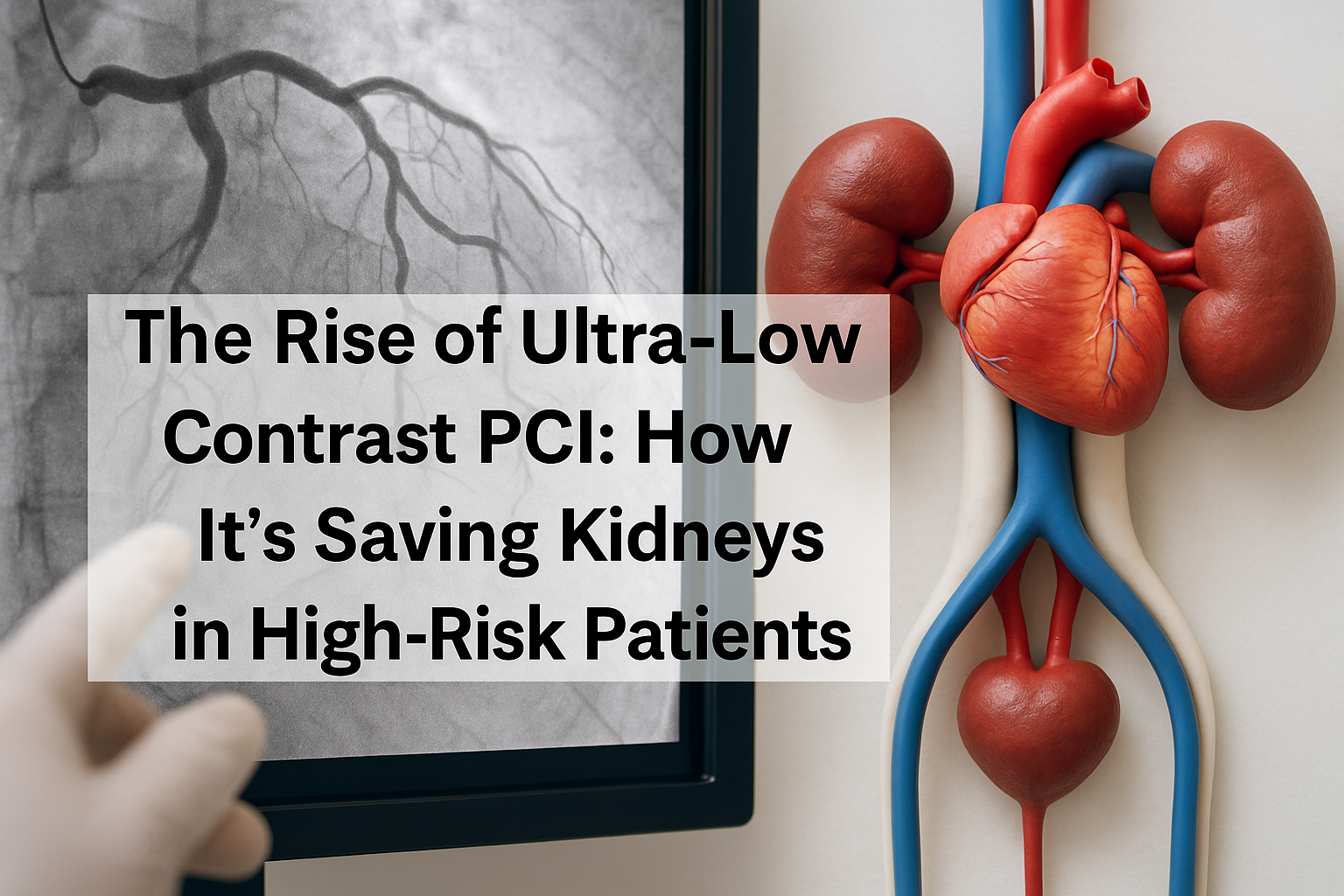
Coronary angioplasty has transformed the way doctors treat heart blockages, helping millions of people avoid heart attacks, heart failure, and major cardiac complications. However, for one important group of patients — those with chronic kidney disease (CKD) or borderline kidney function — angiography and PCI come with an additional risk: contrast-induced acute kidney injury (CI-AKI).
This complication, caused by the iodine-based contrast dye used during angioplasty, has historically been one of the biggest challenges in managing heart disease among kidney-sensitive patients. Over the past decade, however, cardiology has witnessed a major breakthrough: the development of ultra-low contrast PCI and, in some centres, complete zero-contrast PCI.
This innovative approach is allowing interventional cardiologists to treat complex heart blockages safely — while dramatically reducing kidney stress. The results are life-changing, especially for patients who previously had limited treatment options.
This article explores how ultra-low contrast PCI works, why it matters, what technologies make it possible, and how it is changing outcomes for high-risk patients.
Conventional angioplasty uses contrast dye to visualise coronary arteries under X-ray. While safe for most, the dye can be harmful to patients with:
Chronic kidney disease
Diabetes
Long-standing hypertension
Older age
Heart failure
Dehydration
Multiple comorbidities
Previous episodes of kidney injury
In these patients, contrast dye may lead to contrast-induced acute kidney injury, where kidney function suddenly deteriorates after the procedure. In severe cases, this can result in:
Prolonged hospitalisation
Need for dialysis
Worsening long-term kidney function
Higher cardiovascular risk
Increased mortality
Earlier, patients with poor kidney function were often denied angioplasty, asked to undergo surgery instead, or treated medically due to fear of kidney damage. Ultra-low contrast PCI is changing this landscape.
Ultra-low contrast PCI refers to performing coronary angioplasty using minimal amounts of contrast dye, often:
Less than 15–20 ml, or
A contrast volume equal to or less than the patient’s GFR (glomerular filtration rate), or
Using fluoroscopic guidance + intravascular imaging rather than contrast-filled views
In comparison, traditional PCI may use:
100–200 ml of contrast for a simple case
250–350 ml or more for complex blockages
Some advanced centres can even perform zero-contrast PCI, where no new contrast is injected during the procedure.
This approach makes PCI significantly safer for patients at risk of kidney injury, without compromising the accuracy or quality of the treatment.
The success of this technique depends on four major pillars:
IVUS (Intravascular Ultrasound) and OCT (Optical Coherence Tomography) allow cardiologists to visualise the artery from inside, replacing the need for contrast.
Imaging helps in:
Measuring lesion length
Assessing calcium, plaque burden, and vessel diameter
Guiding balloon sizing
Ensuring optimal stent expansion
Checking for complications (dissections, malapposition)
IVUS is particularly useful in zero-contrast PCI because it requires no dye.
If a diagnostic angiogram exists, cardiologists use it:
As a roadmap
To mark lesion location
To identify branches and landing zones
To plan guidewire pathways
This eliminates the need to repeat multiple contrast injections.
By aligning:
Catheter markers
Guidewire tips
Radiopaque stent edges
Vessel landmarks (calcified spots)
…cardiologists can position and deploy stents accurately without contrast.
These tools measure pressure differences across blockages, helping determine:
Whether a blockage truly needs a stent
If additional lesions are significant
Physiology allows for targeted treatment and avoids unnecessary stenting.
Though highly specialised, the workflow follows a disciplined structure:
Patients are optimised with:
IV hydration
Avoidance of nephrotoxic drugs
Tight control of BP and glucose
Instead of performing a new dye injection, the previous angiogram serves as the baseline.
The cardiologist advances wires by matching anatomical references.
This gives accurate vessel sizing and lesion characterisation.
With intravascular imaging, stents are placed with precision, often more accurately than with contrast alone.
IVUS confirms:
Full stent expansion
No residual blockage
No complications
Only if necessary, a single small contrast injection may be used at the end — in many cases, even this is avoided.
Ultra-low contrast PCI is especially valuable for:
The highest-risk group, often previously considered unsuitable for angioplasty.
Their kidneys are more vulnerable to contrast-related damage.
Sensitivity to dye and multiple comorbidities make them ideal candidates.
Excess fluid or poor renal perfusion increases their AKI risk.
Where traditional PCI would require heavy contrast.
Those who developed kidney injury after earlier angiography.
Ultra-low contrast PCI is expanding safe treatment options for all these groups.
The biggest advantage — dramatically lower rates of CI-AKI.
Left main, bifurcation lesions, long calcified segments — all can be treated with confidence.
Earlier, many CKD patients were advised surgery or medical therapy alone.
Avoiding contrast eliminates the renal insult that pushes borderline patients into dialysis.
Better kidney preservation means quicker discharge and fewer complications.
Improved kidneys = improved heart outcomes.
Interventional cardiologists now routinely perform:
Left Main Stenting
Bifurcation PCI (DK crush, TAP, Culotte)
Long-segment diffuse disease
Chronic total occlusions (CTO) in selected centres
Multi-vessel stenting
Heavily calcified lesions with rotational atherectomy / IVL
…all with minimal contrast volumes.
This proves that ultra-low contrast PCI is not a compromise — it is an evolution of PCI quality.
While powerful, ultra-low contrast PCI:
Requires deep expertise
Demands familiarity with intravascular imaging
Is best performed at centres with strong imaging infrastructure
Needs skilled operators trained in landmark-based navigation
Not all hospitals are equipped for zero-contrast PCI yet, but the numbers are growing as outcomes speak for themselves.
Advanced technologies are making kidney-safe PCI even more feasible:
Artificial intelligence–guided vessel reconstruction
Fusion imaging combining angiograms + IVUS data
3D mapping for coronary navigation
Better catheter markers and radiopaque stents
The future is likely to see:
Routine zero-contrast PCI for CKD patients
Contrast-free diagnostic imaging using CT or MRI advancements
AI-driven vessel modeling before PCI
The trend is clear — more precision, less dye, safer kidneys.
Yes. Studies have shown equal or even better outcomes because imaging ensures precise stent placement and full expansion.
While especially beneficial for CKD and diabetic patients, any patient can undergo it. The approach is tailored depending on lesion complexity.
In experienced hands, yes. It is increasingly used for high-risk kidney patients where any dye can be harmful.
It may be slightly longer due to imaging steps, but the improved safety and precision make it worthwhile.
Yes. Even if minimal contrast is used, hydration supports kidney function.
Yes, though contrast may be used sparingly if needed for life-saving clarity.
Your cardiologist will assess your kidney function (creatinine, eGFR), comorbidities, and the complexity of your heart blockages.
 +(91)9810466173
 info@drsanjeevgeracardiologist.com