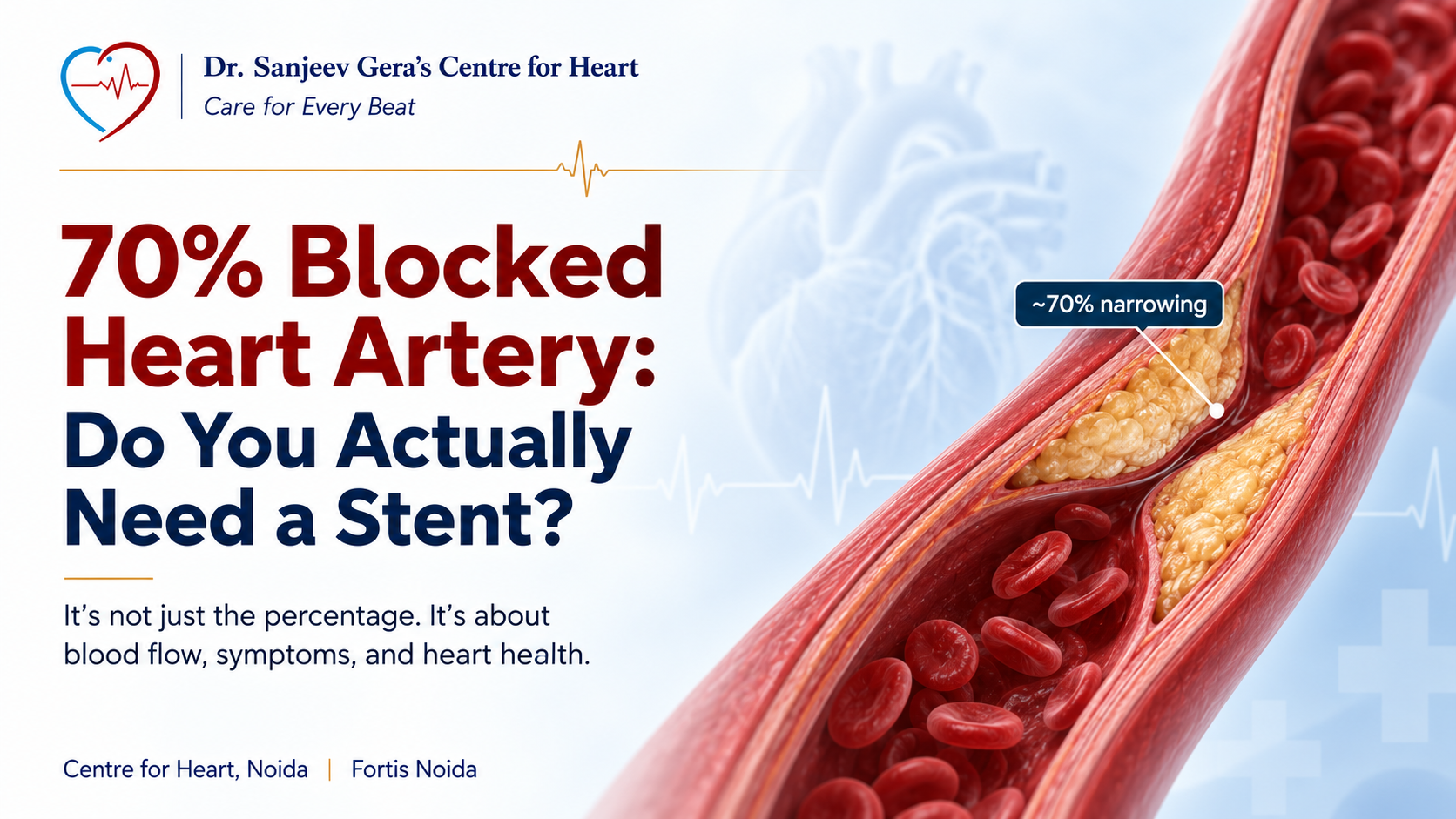
Seeing the words “70% blockage” on a coronary angiogram can be frightening.
For many patients, the immediate assumption is:
“If the artery is 70% blocked, I must need a stent.”
But coronary artery disease is not treated by percentage alone.
A blockage that looks severe on an angiogram may not always be restricting blood flow enough to require a stent. In another patient, a similar-looking blockage may be causing significant reduction in blood supply to the heart muscle and may genuinely need intervention.
That is why the better question is not:
“How much is the artery blocked?”
It is:
“Is this blockage actually limiting blood flow to the heart, causing symptoms, or putting important heart muscle at risk?”
For stable patients, deciding between medicines and angioplasty often requires looking beyond the angiogram and understanding the actual effect of the blockage on the heart.
Coronary arteries supply oxygen-rich blood to the heart muscle.
Over time, cholesterol, inflammatory tissue and calcium can accumulate inside the artery wall and form atherosclerotic plaque.
As the plaque grows, the open channel through which blood travels becomes narrower.
During coronary angiography, doctors estimate how much the artery has narrowed compared with a nearby normal-looking segment.
So when someone is told:
“You have a 70% blockage,”
it usually means that the artery appears significantly narrowed on the angiogram.
But this percentage is primarily an anatomical estimate.
It tells us what the artery looks like.
It does not always tell us exactly how much that narrowing is affecting blood flow.
And that distinction can completely change the treatment decision.
This is one of the most important things patients should understand.
Not every coronary narrowing should immediately be treated with angioplasty.
In many patients with stable coronary artery disease, treatment may begin with:
A stent becomes more relevant when the blockage is causing significant symptoms or when there is convincing evidence that blood supply to an important area of heart muscle is inadequate.
A coronary angiogram is extremely useful, but it is essentially a two-dimensional X-ray view of a three-dimensional artery.
Two blockages that both appear to be “70%” can behave very differently.
One may allow adequate blood flow during exercise.
Another may significantly reduce blood flow when the heart needs more oxygen.
The location and shape of the blockage also matter.
For example, the impact may differ depending on whether the narrowing is:
This is why modern coronary assessment increasingly focuses not only on how the blockage looks, but also on what it is doing physiologically.
The medical term for inadequate blood supply to the heart muscle is ischemia.
A coronary artery can look narrowed without necessarily causing significant ischemia.
Conversely, certain blockages can produce meaningful ischemia and symptoms even when the percentage estimate is not perfectly clear.
When the significance of a blockage is uncertain, doctors may use additional tests to determine whether the narrowing is truly limiting blood flow.
This is where technologies such as FFR and iFR become valuable.
FFR stands for Fractional Flow Reserve.
It is a pressure-based test performed inside the coronary artery during angiography.
A very fine pressure wire is passed across the blockage.
The cardiologist then compares the pressure before and after the narrowed segment.
This helps determine whether the blockage is causing a physiologically important reduction in blood flow.
In simple terms, FFR asks:
“Is this blockage severe enough to reduce blood supply to the heart muscle?”
If the blockage is not significantly restricting flow, a stent may provide little additional benefit in a stable patient.
If the measurement shows important flow limitation, revascularisation may be considered depending on the patient’s overall situation.
iFR stands for Instantaneous Wave-Free Ratio.
Like FFR, it uses a pressure wire to determine whether a narrowing is functionally important.
The major difference is that iFR measures the pressure relationship during a particular phase of the heartbeat and generally does not require the medication commonly used during traditional FFR assessment.
For patients, the important point is not the technical difference between the two.
It is that both can help answer a question an angiogram alone may not fully answer:
“Does this blockage really need to be opened?”
Suppose two patients both have what appears to be a 70% narrowing.
The patient has no significant symptoms.
Blood-flow assessment suggests that enough blood is still reaching the heart muscle.
In such a situation, medication and aggressive risk-factor control may be appropriate.
The patient develops chest pressure every time they walk quickly or climb stairs.
Testing shows that the narrowing is significantly restricting blood supply to a substantial area of heart muscle.
In this situation, angioplasty and stenting may provide meaningful symptom relief and improve blood flow.
The angiogram may look similar.
The physiological effect is different.
There are situations where the decision may be much more urgent.
When an artery suddenly becomes blocked during certain types of heart attack, urgent angioplasty may be lifesaving.
The goal is to restore blood flow to threatened heart muscle as quickly as possible.
This is very different from discovering a stable 70% blockage during an elective evaluation.
A patient may be taking appropriate medications but still experience:
If a coronary blockage is clearly responsible, angioplasty may improve symptoms and quality of life.
If physiological or stress testing demonstrates that a substantial area of heart muscle is receiving inadequate blood supply, revascularisation may be appropriate.
The choice between angioplasty and bypass surgery depends on the anatomy and overall pattern of disease.
Some blockages deserve particular attention because of where they are located.
Examples can include significant disease involving:
In these situations, treatment decisions may involve a broader discussion about angioplasty versus bypass surgery.
Absence of chest pain does not always mean the blockage is harmless.
Some patients have silent ischemia.
This is particularly relevant in people with:
Instead of classic chest pain, they may notice:
This is why symptoms must be interpreted in the context of the patient as a whole.
Chest pain can have many causes.
Even in someone with coronary artery disease, every episode of discomfort is not automatically due to a particular blockage.
Other causes can include:
If a specific narrowing does not appear to be limiting blood flow, simply placing a stent in that segment may not solve the patient’s symptoms.
Correct diagnosis is more important than treating an angiogram image.
An angiogram shows the silhouette of the inside of an artery.
But treatment should not be based only on how dramatic the picture looks.
A visually severe narrowing naturally attracts attention.
However, modern interventional cardiology asks several additional questions:
Is it restricting blood flow?
Is the patient symptomatic?
How much heart muscle does this vessel supply?
Is the heart muscle still viable?
Will intervention improve the patient’s life or prognosis?
Is angioplasty better than medication or bypass surgery in this particular case?
The best treatment targets the patient’s disease—not simply the most impressive-looking image.
IVUS — Intravascular Ultrasound — provides a view from inside the coronary artery.
A tiny ultrasound catheter is passed through the vessel.
It can show:
IVUS can be particularly valuable when the angiogram does not clearly show the severity or anatomy of a lesion.
It can also help optimise stent implantation when PCI is performed.
Optical Coherence Tomography, or OCT, is another form of intracoronary imaging.
It provides extremely detailed images of the inside of the artery.
OCT can help assess:
IVUS and OCT answer different questions from FFR and iFR.
A useful way to understand them is:
FFR/iFR → Is the blockage significantly affecting blood flow?
IVUS/OCT → What does the artery and plaque actually look like from inside?
In complex cases, these technologies can complement each other.
This is another common misconception.
If a cardiologist recommends medications instead of immediate stenting, some patients worry that the disease is being ignored.
But modern treatment of coronary artery disease is much broader than placing a stent.
Medication can address the biological disease that caused the blockage in the first place.
Treatment may include therapies to:
A stent treats a particular narrowed segment.
Medical therapy treats the underlying coronary disease throughout the cardiovascular system.
Both can be important.
During angioplasty, a balloon is used to expand the narrowed artery.
A stent—a small metallic mesh scaffold—is then placed inside the vessel to help keep it open.
This can improve blood flow across a significant narrowing.
For patients whose symptoms are truly caused by that blockage, this can lead to:
However, a stent does not remove the tendency to develop atherosclerosis elsewhere.
That is why medications and lifestyle management remain important even after successful angioplasty.
Some patients believe:
“The blockage has been fixed, so I no longer need cholesterol tablets.”
This can be dangerous thinking.
Coronary artery disease affects more than the one area treated with a stent.
There may be plaque throughout multiple coronary arteries.
After angioplasty, patients may still need medications for:
Do not stop prescribed cardiac medications without discussing it with your treating doctor.
It can progress over time, but coronary events are more complicated than simply watching a blockage grow from 70% to 80%, then 90%, then 100%.
Some heart attacks occur when an atherosclerotic plaque becomes unstable, ruptures and suddenly triggers clot formation.
This can occur even at sites that were not previously causing severe narrowing.
That is another reason why prevention matters so much.
Controlling cholesterol, diabetes, blood pressure, smoking and other risk factors helps address cardiovascular risk beyond a single blockage.
No.
A stent treats a particular coronary lesion.
It does not remove every plaque from every artery.
A person who has undergone angioplasty still needs long-term cardiovascular prevention.
That includes appropriate medical treatment and risk-factor modification.
Location matters.
The left main coronary artery supplies blood to a very large portion of the heart through its major branches.
Significant disease in this area deserves particularly careful evaluation.
Depending on the anatomy, treatment may involve:
The best option depends on factors such as:
This type of disease should not be treated using a simple “percentage equals stent” formula.
If several coronary arteries contain significant disease, doctors consider the pattern as a whole.
For example, a patient with one isolated lesion is very different from a patient with extensive disease across three major vessels.
Depending on the situation, options may include:
For complex disease, the best strategy may require input from interventional cardiologists and cardiac surgeons.
Even very severe-looking blockages need to be interpreted in context.
A 90% narrowing is more likely to significantly restrict blood flow than a moderate lesion, but the treatment decision still depends on:
There is no safe universal rule that says:
“X% blockage always equals stent.”
These are often called intermediate lesions.
This is exactly where physiological assessment can become particularly useful.
An angiogram may not reliably determine whether these lesions are actually restricting blood flow enough to justify PCI.
Depending on the circumstances, doctors may use:
to better understand their significance.
In appropriately selected stable patients, yes.
The decision to defer stenting should be based on proper clinical assessment rather than ignoring the disease.
The patient should continue:
If symptoms change, the treatment plan may need to change as well.
A stable outpatient discussion about whether a 70% blockage needs a stent is very different from a possible heart attack.
Seek emergency medical care for symptoms such as:
Do not wait at home trying to decide what percentage of blockage might be present.
Acute symptoms require urgent evaluation.
If you have been told that an artery is 70% blocked, useful questions include:
A good treatment decision should be understandable to the patient.
In such cases, medication, lifestyle intervention and monitoring may be appropriate.
The final decision must always be personalised.
The phrase “70% blockage” sounds precise.
But in reality, it is only one piece of information.
Modern treatment considers:
Anatomy + Blood Flow + Symptoms + Heart Muscle + Clinical Risk
Rather than simply:
Blockage Percentage = Stent
The purpose of coronary angioplasty is not to make the X-ray look normal.
It is to improve blood flow when doing so genuinely benefits the patient.
Sometimes that means a stent.
Sometimes it means medication first.
Sometimes it means bypass surgery.
And sometimes the right answer becomes clear only after additional physiological or intravascular assessment.
No. A 70% narrowing does not automatically require stenting. The decision depends on whether it significantly limits blood flow, causes symptoms, affects important heart muscle and whether revascularisation offers meaningful benefit.
Doctors use symptoms, angiography and, in selected cases, tests such as FFR, iFR, stress testing, IVUS or OCT to better understand the lesion.
FFR is a pressure-wire test that evaluates whether a coronary narrowing is significantly reducing blood flow.
iFR is another pressure-based method for assessing the functional importance of a coronary blockage.
Medication does not physically remove the plaque, but it can reduce cardiovascular risk, stabilise plaque, control symptoms and slow disease progression. In appropriate stable patients, medication may be the preferred initial treatment.
No. A stent opens a narrowed segment by supporting the artery from inside. It does not remove the underlying tendency to develop atherosclerosis.
Yes. Coronary artery disease can affect many parts of the coronary circulation. Long-term medication and risk-factor management remain essential after stenting.
It can be important, but risk depends on far more than the percentage. Location, blood-flow impact, symptoms, plaque characteristics and overall coronary disease all matter.
For some patients with complex multivessel or left-main coronary disease, bypass surgery may be more appropriate. For others, PCI may be preferable. The decision is individualised.
Dr. Sanjeev Gera
MD, DNB (Cardiology), FSCAI
Centre for Heart, Noida
Fortis Noida
If you have been told that you have a 70% coronary artery blockage, the next question should not automatically be:
“When should I get the stent?”
A better question is:
“Is this blockage actually reducing blood flow enough that opening it will benefit me?”
A detailed review of your symptoms, angiogram, heart function and, where appropriate, physiological or intracoronary imaging can help determine whether medical therapy, angioplasty or bypass surgery is the most appropriate treatment.
 +(91)9810466173
 info@drsanjeevgeracardiologist.com