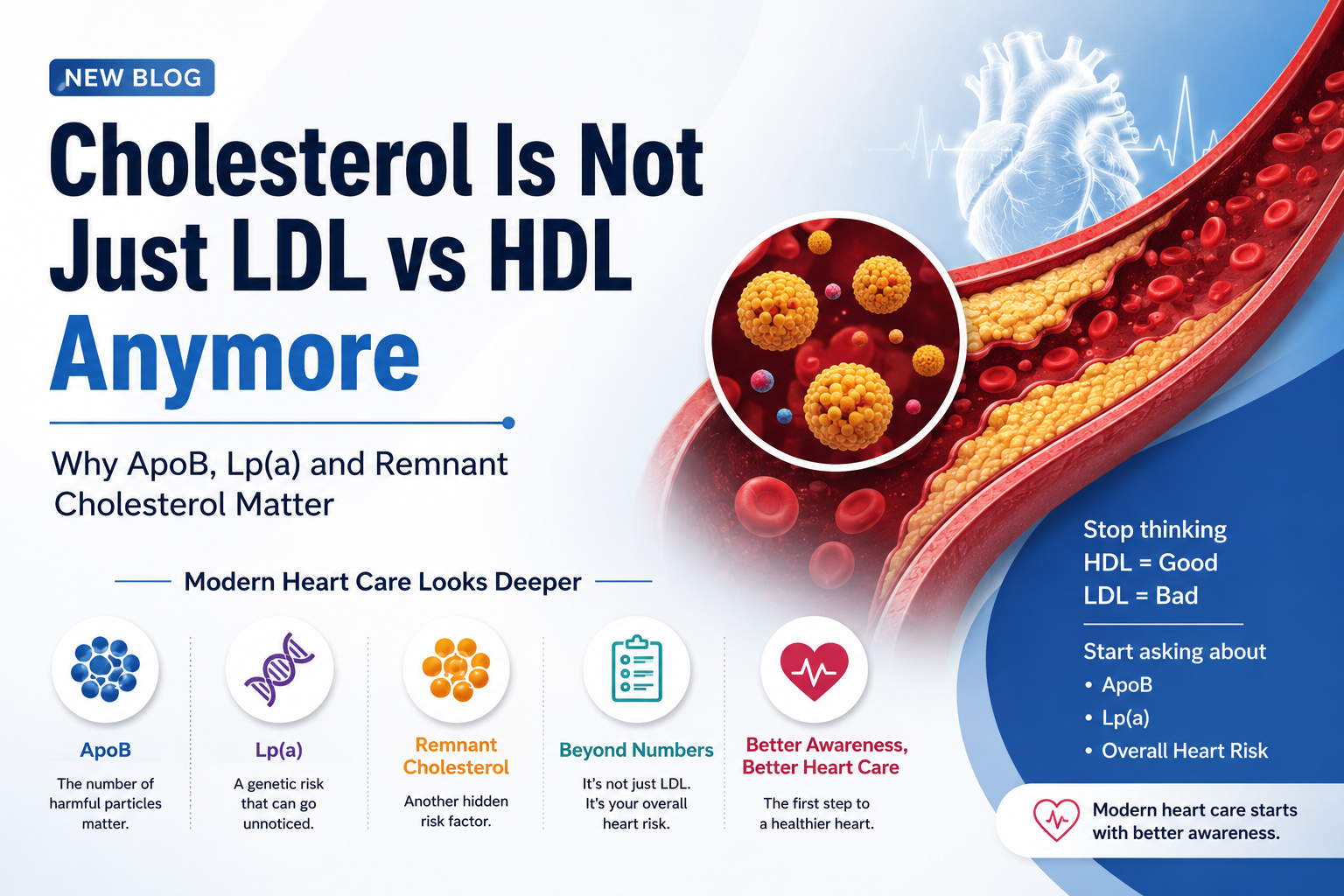
For many years, cholesterol was explained in a very simple way.
LDL was called bad cholesterol.
HDL was called good cholesterol.
Patients were told to reduce fats, eat clean, improve HDL and bring LDL down. For a long time, this explanation helped people understand cholesterol in a simple way.
But modern cardiology has moved forward.
Today, we know that cholesterol risk is not only about one LDL number or one HDL number. The real picture is deeper. There are different types of lipoprotein particles in the blood, and some of them can silently increase the risk of heart attack, stroke and artery blockage.
This is why advanced markers like ApoB, Lp(a), remnant cholesterol and overall cardiovascular risk are becoming more important in heart care.
LDL cholesterol became famous because it is strongly linked with plaque formation inside the arteries. When LDL levels remain high for a long time, cholesterol can slowly build up in the artery walls.
Over time, this can lead to:
Chest pain
Heart attack
Stroke
Narrowing of heart arteries
Need for angioplasty, stents or bypass surgery
Then came statins.
Statins changed cardiology because they helped lower LDL cholesterol and reduce heart attack risk. This made LDL reduction one of the most important goals in preventive cardiology.
But even after LDL was controlled, some people still developed heart disease. Some patients had heart attacks despite “normal” cholesterol reports. This made doctors ask a deeper question:
Are we looking at the full cholesterol risk picture?
Cholesterol does not travel freely in the blood. It moves inside carrier particles called lipoproteins.
Some of these particles can enter the artery wall and contribute to plaque formation. These are called atherogenic particles.
The European Society of Cardiology notes that, apart from LDL, other ApoB-containing lipoproteins such as Lp(a) and cholesterol-rich remnant particles can also contribute to atherosclerosis.
This means cholesterol risk is not only about how much cholesterol is present.
It is also about:
How many harmful particles are circulating
What type of particles are present
Whether hidden markers like Lp(a) are elevated
Whether the patient has diabetes, smoking, BP, obesity or family history
That is why two people with the same LDL number may not have the same heart risk.
One important hidden marker is Lipoprotein(a), also called Lp(a).
Lp(a) is an LDL-like particle with an extra protein attached to it. It is largely genetic, which means it often runs in families. A person may eat well, exercise and still have high Lp(a).
The important point is that Lp(a) is not usually checked in a routine lipid profile.
A routine cholesterol report may show:
Total cholesterol
LDL
HDL
Triglycerides
But Lp(a) may remain hidden unless specifically tested.
High Lp(a) has been associated with increased risk of heart disease and stroke. The American Heart Association notes that Lp(a) levels are largely genetically determined and recommends that adults should have Lp(a) measured at least once in adulthood.
This is especially important for people who have:
Family history of early heart attack
Heart attack at a young age
Repeated artery blockages
Heart disease despite normal LDL
Aortic valve disease
Strong family history of cholesterol problems
Diet and lifestyle are very important for overall heart health, but Lp(a) usually does not come down significantly with diet alone. That is why detecting it early helps doctors manage the patient’s total risk more carefully.
Another important marker is remnant cholesterol.
Remnant cholesterol comes from triglyceride-rich particles. These particles are the leftovers after the body processes fats from food and liver production.
For a long time, most attention was placed on LDL. But now we know remnant particles may also enter the artery wall and add to plaque formation.
Remnant cholesterol is often more concerning in people with:
High triglycerides
Diabetes
Obesity
Fatty liver
Insulin resistance
Metabolic syndrome
Sedentary lifestyle
This is why a person with borderline LDL but high triglycerides and metabolic risk may still have significant heart risk.
This is where ApoB becomes important.
ApoB is a protein found on many harmful cholesterol-carrying particles, including LDL, VLDL remnants and Lp(a). Each of these atherogenic particles usually carries one ApoB protein.
So, ApoB helps estimate the number of harmful particles circulating in the blood.
This matters because LDL cholesterol tells us how much cholesterol is inside LDL particles, but ApoB gives a better idea of how many risky particles are present.
In simple words:
LDL-C = cholesterol amount
ApoB = particle number
This is important because some people may have a normal LDL number but still have a high number of small cholesterol particles. That means their ApoB can be high even when LDL looks acceptable.
This can happen in patients with:
Diabetes
High triglycerides
Abdominal obesity
Metabolic syndrome
Insulin resistance
Family history of heart disease
So, a “normal LDL” does not always mean “no risk.”
For years, HDL was called good cholesterol. Low HDL was considered risky, and people believed that higher HDL was always better.
But today, cardiology has become more careful about this idea.
Very low HDL can be associated with higher risk. But very high HDL is not always automatically protective. More importantly, simply increasing HDL numbers does not always reduce heart attack risk.
The American Heart Association states that HDL is not a treatment target for lowering heart disease or stroke risk in the same way LDL is.
In modern heart care, the focus is not just on whether HDL is “good” or LDL is “bad.”
The focus is on the full risk profile.
Not everyone needs every advanced test immediately. But some people should discuss it with a cardiologist.
You may need a more detailed cholesterol risk assessment if you have:
Family history of heart attack or stroke at a young age
Diabetes or prediabetes
High triglycerides
Obesity or fatty liver
Smoking history
High blood pressure
Previous angioplasty, stent or bypass surgery
Heart attack despite normal cholesterol
Repeated artery blockages
Aortic valve disease
Cholesterol problems from a young age
In such patients, tests like ApoB, Lp(a), non-HDL cholesterol and triglyceride assessment may give a clearer picture.
Instead of asking only, “Is my LDL normal?” patients should start asking better questions.
Ask your cardiologist:
What is my overall heart risk?
Do I need ApoB testing?
Should I check Lp(a) once?
Are my triglycerides and remnant cholesterol increasing my risk?
Is my cholesterol risk higher because of diabetes, BP or family history?
Do I need lifestyle changes, medicines or closer monitoring?
Modern cholesterol care is not about treating one number. It is about understanding the patient’s complete risk.
Even though advanced markers are important, lifestyle remains the foundation of heart protection.
Patients should focus on:
Heart-healthy diet
Regular exercise
Weight control
Avoiding smoking
Controlling blood pressure
Managing diabetes
Reducing processed foods and trans fats
Sleeping well
Regular heart check-ups
Medicines like statins, ezetimibe, PCSK9 inhibitors or other therapies may be advised depending on the patient’s risk profile. Treatment should always be personalized by a qualified cardiologist.
Cholesterol is no longer just:
LDL = Bad
HDL = Good
That old explanation is too simple for today’s understanding of heart disease.
Modern heart care looks deeper.
It asks:
How many harmful particles are present?
Is ApoB high?
Is Lp(a) silently increasing risk?
Are remnant particles contributing to artery blockage?
What is the patient’s total cardiovascular risk?
A normal cholesterol report does not always mean low risk. Better awareness, better testing and timely cardiology evaluation can help detect hidden risks earlier.
Dr. Sanjeev Gera
MBBS, MD – Medicine, DNB – Cardiology
Cardiologist | 20 Years Experience
Fortis Institute of Cardiovascular Sciences
Rasoolpur Nawada, Industrial Area, Sector 62, Noida, Uttar Pradesh 201301
Dr. Sanjeev Gera’s Center for Heart
BF-45, 93 & 94, Phase-2, Plot A&B Tower-B, Spectrum Mall, Sector-75, Noida, UP-201316
Note: All interventions are performed at Fortis Hospital, Noida.
Yes. LDL remains a very important marker for heart disease risk. But it is not the only marker. ApoB, Lp(a), triglycerides, remnant cholesterol and overall risk also matter.
Yes. Some people may have normal LDL but high ApoB, high Lp(a), diabetes, high triglycerides or strong family history. These factors can increase heart risk.
ApoB is a protein found on harmful cholesterol-carrying particles. It helps estimate the number of atherogenic particles in the blood.
Lp(a) is a genetic cholesterol-related particle that can increase heart disease and stroke risk. It is not usually part of a routine lipid profile and may need a separate test.
Diet improves overall heart health, but Lp(a) is mostly genetic and usually does not reduce significantly with diet alone.
Not always. Very low HDL may be risky, but very high HDL is not always protective. HDL function matters more than just the number.
People with family history of early heart disease, diabetes, high triglycerides, repeated blockages, heart attack at a young age or heart disease despite normal LDL should discuss advanced testing with a cardiologist.
 +(91)9810466173
 info@drsanjeevgeracardiologist.com