Coronary artery disease is one of the most common heart conditions today. It happens when fatty deposits, calcium, or plaque build up inside the arteries that supply blood to the heart. When the artery becomes narrow, blood flow reduces, and a person may experience chest pain, breathlessness, fatigue, or in severe cases, a heart attack.
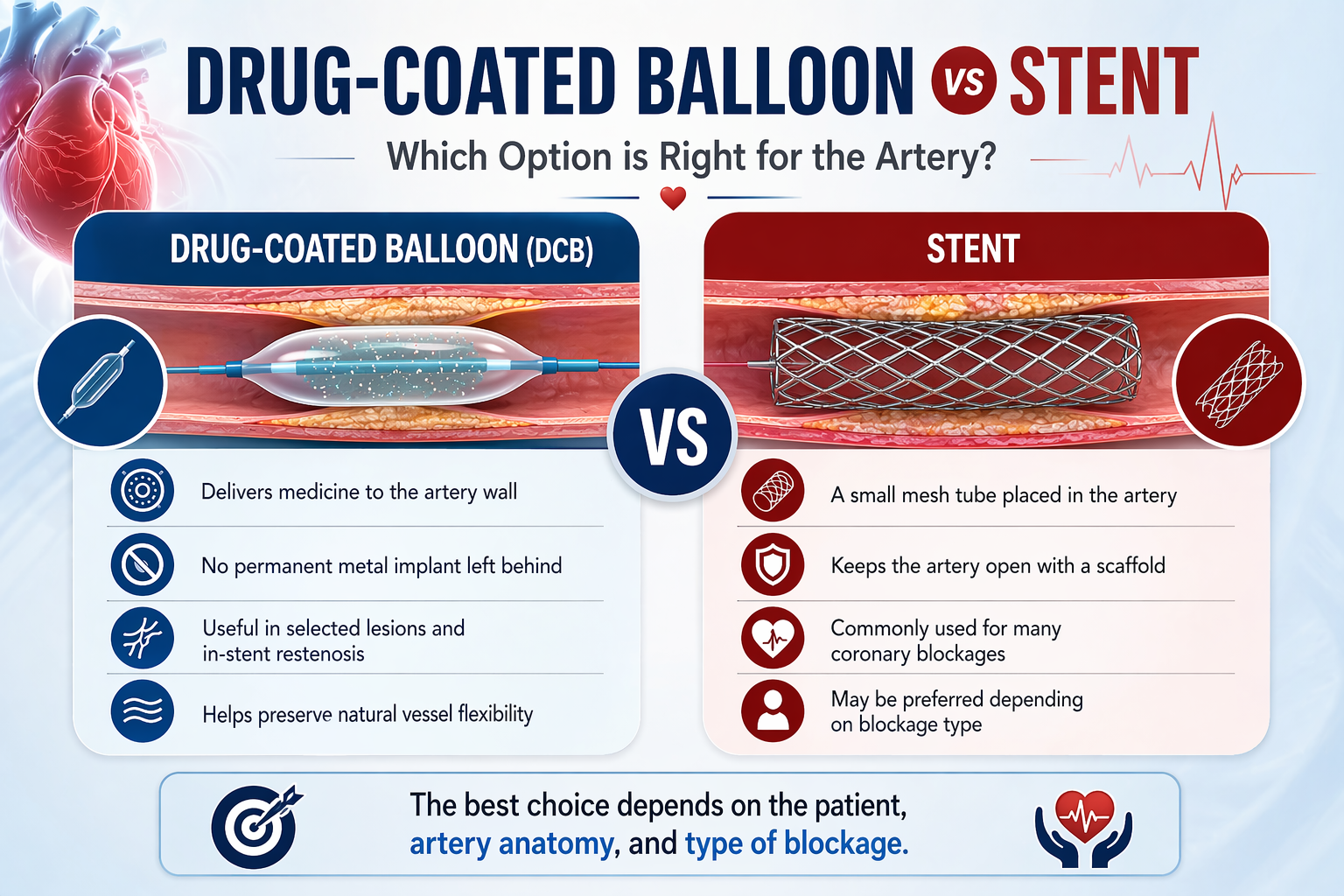
Modern interventional cardiology offers several ways to open blocked arteries. Two important treatment options are drug-coated balloon angioplasty and stent placement. Both are used during angioplasty procedures, but they work differently. A stent stays inside the artery as a small metal scaffold, while a drug-coated balloon delivers medicine to the artery wall and is then removed.
Understanding the difference between a drug-coated balloon and a stent can help patients have better discussions with their cardiologist.
A drug-coated balloon, also called a DCB, is a special angioplasty balloon coated with medication. During the procedure, the balloon is placed inside the narrowed part of the artery and inflated for a short time.
When inflated, the balloon opens the narrowed artery and transfers medicine to the artery wall. This medicine helps reduce the chance of the artery narrowing again. After the medicine is delivered, the balloon is deflated and removed from the body.
The key point is that no permanent metal implant is left behind.
A stent is a tiny mesh-like tube placed inside the artery to keep it open. During angioplasty, a balloon expands the stent at the site of blockage. Once expanded, the stent remains permanently inside the artery and works like a scaffold.
Most modern stents are drug-eluting stents, which slowly release medicine to reduce the risk of re-narrowing. Stents are widely used for many types of coronary blockages and have helped millions of patients worldwide.
The biggest difference is this:
A drug-coated balloon delivers medicine and leaves nothing behind, while a stent keeps the artery open with a permanent metal scaffold.
This does not mean one option is always better than the other. The right choice depends on the patient’s condition, artery size, blockage pattern, vessel anatomy, and clinical judgement of the cardiologist.
In a DCB procedure, the cardiologist first prepares the blocked artery. This may involve using a regular balloon or other techniques to open the narrowed area. Once the artery is properly prepared, the drug-coated balloon is positioned at the target site.
The balloon is inflated for a specific duration so that the medicine can transfer into the artery wall. After that, the balloon is removed. The medicine continues to act locally and helps prevent excessive tissue growth that can cause re-narrowing.
DCBs may be useful in selected cases, especially when doctors want to avoid leaving another metal layer inside the artery.
In a stent procedure, the stent is mounted on a balloon catheter and guided to the blocked artery. When the balloon is inflated, the stent expands and presses the plaque against the artery wall. The stent remains there permanently to support the artery.
A drug-eluting stent also releases medicine over time to reduce restenosis. Because it provides strong structural support, a stent is often preferred in blockages where the artery needs scaffolding to stay open.
A drug-coated balloon may be considered in selected situations such as:
In-stent restenosis, where a previously placed stent becomes narrowed again.
Small vessel disease, where placing a stent may be less suitable.
Certain lesions where preserving natural vessel flexibility is important.
Cases where avoiding a permanent implant may be beneficial.
However, DCB treatment is not suitable for every blockage. Proper lesion preparation and careful assessment are very important for good results.
A stent may be preferred when the artery needs strong support after opening the blockage. This can include larger coronary arteries, complex blockages, dissections, or situations where the vessel is likely to collapse without support.
Stents are commonly used in coronary angioplasty because they provide reliable mechanical support. In many cases, a stent is the standard and most effective option.
One major advantage of DCB therapy is that it does not leave a permanent metal implant behind. This helps preserve the natural movement and flexibility of the artery.
It may also be helpful in patients who already have a stent and develop re-narrowing inside it. Instead of adding another metal layer, the cardiologist can deliver medicine through the balloon.
DCBs may also reduce long-term implant-related concerns in carefully selected patients.
The biggest benefit of a stent is that it gives immediate structural support to the artery. It helps keep the vessel open and improves blood flow to the heart muscle.
Modern drug-eluting stents are highly advanced and have made angioplasty safer and more effective. They are widely used for many coronary artery blockages and are supported by strong clinical experience.
For many patients, a stent remains the best choice.
Not always. A drug-coated balloon is not a replacement for stents in every case. It is a valuable option for specific artery conditions.
Similarly, a stent is not always required in every situation. Some patients may benefit from a “leave nothing behind” approach using DCB.
The best option depends on several factors, including:
The size of the artery
The type and length of blockage
Whether a stent was already placed before
The amount of calcium in the artery
Blood flow after balloon preparation
Risk of re-narrowing
Patient’s bleeding risk and medication suitability
Choosing between a drug-coated balloon and a stent requires expertise. The cardiologist studies the angiogram, evaluates the artery anatomy, and may use advanced imaging techniques such as IVUS or OCT when required.
These imaging tools help doctors see the artery from inside and make more precise decisions. They can help assess plaque, calcium, vessel size, stent expansion, and lesion preparation.
This is why treatment should always be personalized.
Recovery after angioplasty is usually faster than open-heart surgery. Most patients can walk within a short time and may return to routine activities based on the doctor’s advice.
Patients are usually advised to take medicines regularly, follow a heart-healthy diet, control diabetes and blood pressure, stop smoking, exercise safely, and attend follow-up visits.
Whether a patient receives a DCB or stent, lifestyle changes remain extremely important.
Patients may need blood-thinning medicines after both procedures. The duration may vary depending on the treatment type, patient risk factors, and doctor’s decision.
After a stent, dual antiplatelet therapy is commonly required for a specific period. After DCB, the medicine duration may sometimes differ, but this must be decided only by the treating cardiologist.
Patients should never stop heart medicines without medical advice.
Both drug-coated balloons and stents are important tools in modern angioplasty. A stent provides permanent support to keep the artery open, while a drug-coated balloon delivers medicine without leaving a permanent implant.
There is no single “best” option for every patient. The right choice depends on the patient, artery anatomy, and type of blockage. A skilled interventional cardiologist can decide the safest and most effective approach after proper evaluation.
For patients with coronary artery disease, timely diagnosis, expert treatment, and long-term lifestyle management can make a major difference in heart health.
A drug-coated balloon delivers medicine to the artery wall and is removed after inflation. A stent is a small mesh tube that remains permanently inside the artery to keep it open.
No. A drug-coated balloon does not leave a permanent metal implant behind. It delivers medicine and is then removed.
Yes. A stent remains permanently inside the artery and works as a scaffold to keep the artery open.
Neither is universally better. The right option depends on the artery size, blockage type, previous stent history, vessel anatomy, and the cardiologist’s assessment.
It may be used in selected cases such as in-stent restenosis, small vessel disease, or situations where avoiding a permanent implant is preferred.
A stent is commonly used when the artery needs strong structural support to remain open after angioplasty.
In properly selected patients and when performed by an experienced cardiologist, DCB angioplasty can be a safe and effective option.
Yes, in-stent restenosis is one of the important situations where a drug-coated balloon may be considered.
Most patients need antiplatelet medicines after angioplasty. The type and duration depend on the procedure and patient factors. Follow your cardiologist’s advice strictly.
Yes. A healthy diet, regular exercise, diabetes and BP control, cholesterol management, avoiding smoking, and regular follow-up can reduce future heart risks.
 +(91)9810466173
 info@drsanjeevgeracardiologist.com