HEART HEALTH
By Dr. Sanjeev Gera, Interventional Cardiologist · 5 min read
Imagine a single main road feeding an entire city, just before it divides into two highways. Block that one stretch and both highways, and everything beyond them, feel it.
That is what a left main blockage does to the heart. Here is why this short artery matters so much, how it is treated, and why it deserves extra care.
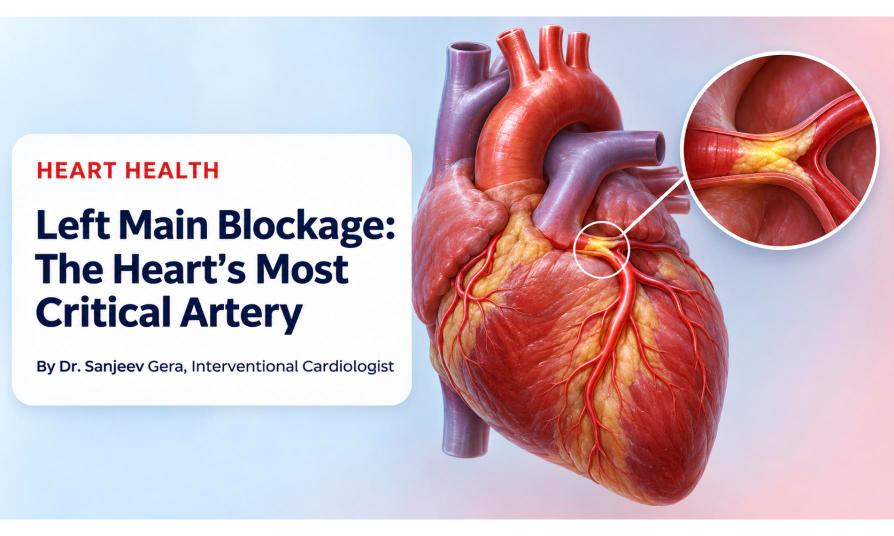
The left main coronary artery is the short trunk that comes off the aorta. It soon divides into the left anterior descending (LAD) artery and the left circumflex artery. Together, these supply much of the heart’s main pumping chamber, the left ventricle.
A blockage in a smaller branch affects the muscle that branch supplies. A blockage in the left main sits upstream of both major branches, so a sudden problem here can threaten a large part of the heart at once.
It isn’t the length of the artery that matters.
It’s how much heart depends on it.
That is why a significant left main narrowing should never be left to “wait and watch” without a specialist’s opinion.
Some people, particularly those with diabetes, may have mild or no symptoms. Sudden or severe chest pain is an emergency. Call an ambulance or go to the nearest emergency department straight away.
A coronary angiogram shows the narrowing. Because the left main can be hard to judge from the outside view alone, doctors often add IVUS or OCT imaging from inside the artery, or a pressure-wire test, to measure how serious it is.
| Angioplasty with stent | Bypass surgery (CABG) | |
|---|---|---|
| Approach | Thin tube, usually through the wrist | Open heart operation |
| Often suits | Simpler disease in suitable anatomy | Complex disease in several arteries |
| Recovery | Usually days | Usually weeks |
| After treatment | Blood thinners exactly as prescribed | Rehabilitation and long-term medicines |
Neither option is right for everyone. Ideally, the cardiologist and cardiac surgeon review your case together as a heart team.
Not always, but it always needs prompt specialist review. How urgent it is depends on the severity and your symptoms.
Yes, in suitable patients. Your anatomy and overall health decide whether a stent or bypass is the better choice.
Medicines are essential, but a significant left main narrowing usually needs a procedure as well. Your cardiologist will advise you.
No. Never stop them without asking your cardiologist.
Understand your options clearly before you decide.
This article is for general education and isn’t a substitute for personal medical advice. Please consult your cardiologist about your specific condition.
 +(91)9810466173
 info@drsanjeevgeracardiologist.com