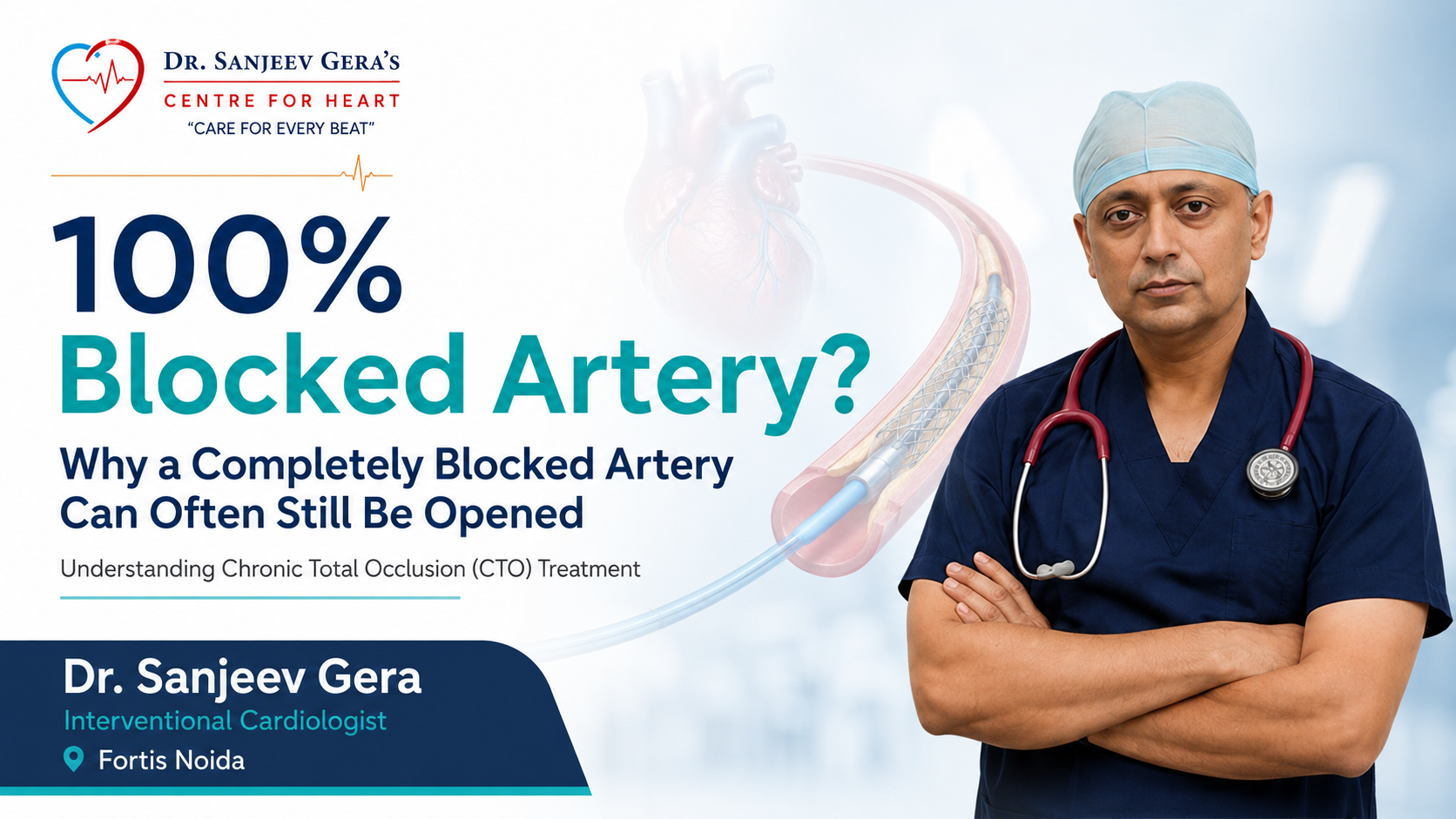
Being told that one of your heart arteries is 100% blocked can sound frightening and final.
Many patients hear statements such as:
“The artery is completely closed.”
“A stent cannot pass through it.”
“It has probably been blocked for years.”
“Nothing can be done.”
But a completely blocked coronary artery does not always mean treatment is impossible.
In selected patients, a long-standing 100% blockage—called a Chronic Total Occlusion, or CTO—can sometimes be reopened using advanced angioplasty techniques performed by cardiologists experienced in complex coronary interventions.
The key question is not simply:
“Can this artery be opened?”
The more important question is:
“Will opening this artery improve the patient’s symptoms, heart function or quality of life, and can it be done safely?”
A Chronic Total Occlusion is a coronary artery that has remained completely blocked for a prolonged period, generally for several months or longer.
This is different from the sudden blockage that occurs during an acute heart attack.
Over time, a CTO can become extremely hard because the blockage may contain:
Because of this, a normal angioplasty guidewire may not easily pass through the blockage.
That is why CTO angioplasty is considerably more complex than routine angioplasty.
This is one of the first questions many patients ask.
If an artery is completely blocked, how is the heart muscle still functioning?
The answer is often collateral circulation.
When an artery becomes blocked gradually, the heart may develop small alternative blood vessels that bring blood to the affected area from neighbouring coronary arteries.
Think of them as temporary side roads around a blocked highway.
These collateral vessels can sometimes provide enough blood to keep the heart muscle alive.
However, they may not always provide sufficient blood during physical activity.
This is why patients with a CTO may still experience:
Some patients do not realise how limited they have become because they slowly reduce their activity over time.
There are several reasons.
A CTO is one of the most technically demanding problems in coronary intervention.
In routine angioplasty, a guidewire usually travels through the natural channel of the artery.
In a CTO, that channel may be completely sealed.
The cardiologist may need to navigate through a long segment containing hard plaque, calcium and scar tissue.
This requires:
Not every catheterisation laboratory regularly performs these procedures.
As a result, a patient may be told that the artery cannot be opened when what is really meant is:
“This cannot be safely or reliably treated using routine angioplasty techniques here.”
For selected patients, referral to a centre experienced in complex CTO interventions may provide another option.
No.
This is extremely important.
The goal of CTO angioplasty is not simply to make an angiogram look better.
A completely blocked artery does not automatically require a stent.
Treatment should be considered based on the entire clinical picture.
Doctors may evaluate:
For some patients, medication alone may be appropriate.
For others, bypass surgery may be the better option.
And for carefully selected patients, CTO angioplasty can be considered.
A chronic total occlusion may not always produce classic chest pain.
Some patients instead notice that everyday activities gradually become more difficult.
Symptoms can include:
This may appear while:
The discomfort often improves after resting.
Some patients primarily experience shortness of breath rather than obvious chest pain.
They may notice that activities that were previously easy suddenly require frequent breaks.
A patient may say:
“I can still walk, but I cannot walk as far as I used to.”
Or:
“I have slowed down over the last few years.”
Sometimes patients unconsciously adjust their lifestyle around their symptoms.
Poor blood supply to the heart during exertion can sometimes present as unexplained tiredness or exhaustion.
Imagine trying to pass a thin wire through a tunnel.
In a normal artery, the tunnel remains open.
In a CTO, that tunnel may be completely filled with hard material.
The beginning of the blockage can also be difficult to identify.
In addition, the blocked segment may be:
This is where specialised CTO techniques become important.
CTO angioplasty uses several advanced strategies.
The exact technique depends on the anatomy of the blockage.
This is often the first approach.
The cardiologist tries to cross the blockage from the beginning of the blocked artery toward the far end.
A series of increasingly specialised guidewires may be used to carefully navigate through the blockage.
Once the wire successfully reaches the true artery beyond the obstruction, the channel can be enlarged and treated with balloons and stents.
Sometimes it is extremely difficult to remain within the original tiny pathway through the blockage.
In selected cases, the cardiologist may intentionally navigate around part of the blocked segment within the vessel wall and then carefully re-enter the normal artery beyond the blockage.
This is known as a dissection and re-entry strategy.
Specialised equipment may be used to make this process more controlled.
This is one of the most advanced approaches.
Instead of approaching the blocked artery only from the front, the cardiologist may use small collateral blood vessels to reach the blocked artery from the opposite direction.
The blockage is then approached from behind.
This is called the retrograde technique.
It can be particularly useful when the beginning of the blockage is extremely difficult to penetrate.
However, retrograde procedures are highly specialised and require considerable experience.
Crossing the CTO with a guidewire is only the first major step.
The artery may then need to be gradually prepared using small balloons.
If there is significant calcium, additional plaque-modification techniques may sometimes be required.
Once adequate blood flow has been restored, one or more drug-eluting stents may be placed to keep the artery open.
The final result is assessed carefully to ensure good blood flow through the treated vessel.
Yes.
Advanced intracoronary imaging can be extremely useful in complex coronary interventions.
Techniques such as IVUS — Intravascular Ultrasound — allow the cardiologist to see the artery from inside.
Imaging can help determine:
Precise imaging can be particularly valuable when treating complicated anatomy.
The most realistic goal of CTO treatment is usually symptom improvement and better quality of life.
Patients who are appropriately selected may experience:
For example, a patient who previously had to stop after walking a short distance may be able to walk farther with fewer symptoms after successful treatment.
However, results vary from patient to patient.
Not necessarily.
CTO angioplasty cannot reverse every effect of coronary artery disease.
If part of the heart muscle has already been permanently damaged by a previous heart attack, restoring blood supply may not fully restore that muscle.
This is why doctors may sometimes perform additional tests to understand whether the affected heart muscle is still viable and likely to benefit from improved blood flow.
Treatment should therefore be based on realistic expectations.
In some carefully selected patients, heart function may improve when blood flow is restored to living but chronically under-supplied heart muscle.
However, this improvement is not guaranteed.
Much depends on:
CTO angioplasty is generally more complex than routine coronary angioplasty.
Procedures may take longer and may require more equipment and X-ray imaging.
Potential complications can include:
The individual risk varies depending on the patient’s health and the complexity of the artery.
This is why careful patient selection and experience in complex coronary intervention are important.
A previous failed CTO angioplasty does not always mean another attempt is impossible.
Sometimes the first attempt provides valuable information about the anatomy of the blockage.
A future procedure may use:
However, another attempt should only be considered when the expected clinical benefit justifies the additional procedure.
Both procedures can be effective in the right patient.
The decision depends on much more than whether one artery is completely blocked.
Bypass surgery may be preferred when there is:
CTO angioplasty may be attractive when:
The decision should be individualised.
Depending on the patient, evaluation may include:
This shows the location, length and complexity of the blockage.
This evaluates heart pumping function and valve function.
This may help determine whether the blocked artery is causing significant reduction in blood supply during activity.
In selected patients with reduced heart function, additional imaging may help determine whether the heart muscle supplied by the blocked artery is still alive.
Because angioplasty requires contrast dye, kidney function is particularly important when planning a complex procedure.
Instead of focusing only on the percentage of blockage, consider asking your cardiologist:
Is this a chronic total occlusion?
Is the heart muscle supplied by this artery still viable?
Is this blockage responsible for my symptoms?
Have I received optimal medical treatment?
Would opening the artery realistically improve my symptoms?
Would bypass surgery be more appropriate?
How complex is my CTO?
Would assessment at a specialised CTO centre be useful?
These questions can help patients understand their options more clearly.
Modern coronary intervention has advanced significantly.
Blockages that would previously have been considered extremely difficult may now sometimes be treated using specialised guidewires, microcatheters, intracoronary imaging and advanced CTO crossing techniques.
But advanced technology does not mean every blocked artery should be opened.
The best treatment depends on:
Symptoms.
Heart muscle viability.
Overall coronary anatomy.
Medical conditions.
Procedural risk.
And the likelihood that treatment will genuinely improve the patient’s life.
So if you have been told:
“That artery is 100% blocked. Nothing can be done.”
It may be reasonable in selected cases to ask whether evaluation by a cardiologist experienced in complex coronary and CTO interventions could provide another perspective.
Yes. Some chronic total occlusions can be successfully treated using specialised CTO angioplasty techniques. However, not every blockage is suitable for treatment.
Yes. If the artery closes gradually, collateral vessels may develop and supply some blood to the affected heart muscle. However, this may not provide enough blood during physical activity.
No. Some patients do well with medication, while others may be better treated with bypass surgery. The decision depends on symptoms, anatomy, heart function and expected benefit.
CTOs can be extremely hard, calcified or long, making them difficult to cross with standard techniques. A specialised CTO approach may sometimes provide additional options.
In appropriately selected patients, successful CTO treatment can significantly reduce angina and improve exercise capacity and quality of life.
It is generally more complex than standard angioplasty and carries additional risks. Careful evaluation and experienced operators are therefore important.
It may improve function in some patients if the heart muscle supplied by the blocked artery is still alive but receiving inadequate blood. Improvement is not guaranteed.
CTO procedures can take considerably longer than routine angioplasty because crossing the blocked artery may require multiple specialised techniques.
Dr. Sanjeev Gera
MD, DNB (Cardiology), FSCAI
Centre for Heart, Noida
Fortis Noida
If you have been diagnosed with a 100% blocked coronary artery or Chronic Total Occlusion, a detailed review of your coronary angiogram, symptoms, heart function and overall health can help determine whether medical therapy, CTO angioplasty or bypass surgery may be appropriate.
The goal is not simply to open an artery.
The goal is to choose the treatment that gives the patient the greatest meaningful benefit with acceptable risk.
 +(91)9810466173
 info@drsanjeevgeracardiologist.com