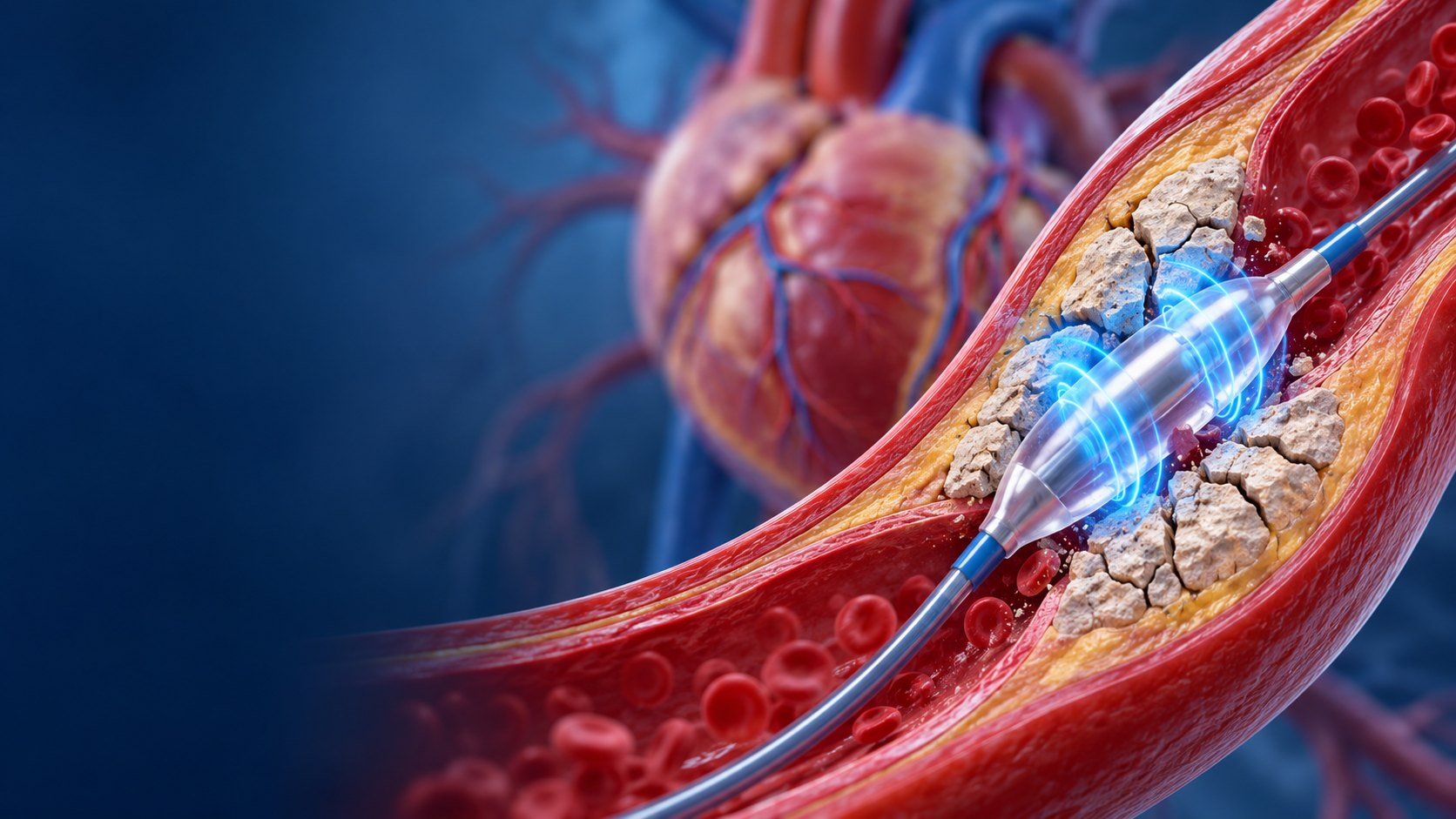
Imagine trying to inflate a balloon inside a steel pipe. No matter how hard you push, the pipe will not stretch. That is exactly the problem cardiologists face when a heart artery is lined with rock-hard calcium.
If you or a family member has been told, “your blockage is heavily calcified”, it can sound alarming. The good news: we now have precise tools designed for exactly this situation.
A blockage usually begins as soft, fatty plaque. Over many years, the body deposits calcium into that plaque, the same mineral found in bone. Slowly, the soft plaque turns into something closer to stone. The artery does not just become narrow. It becomes stiff and unyielding.
Heavy calcification is seen more often in people who:
A stent works well only when it expands fully and sits snugly against the artery wall. Hard calcium gets in the way at every step:
Calcium resists even very high balloon pressures.
A rigid, uneven channel can stop the stent from reaching the blockage.
The biggest concern, linked to re-narrowing or clotting later.
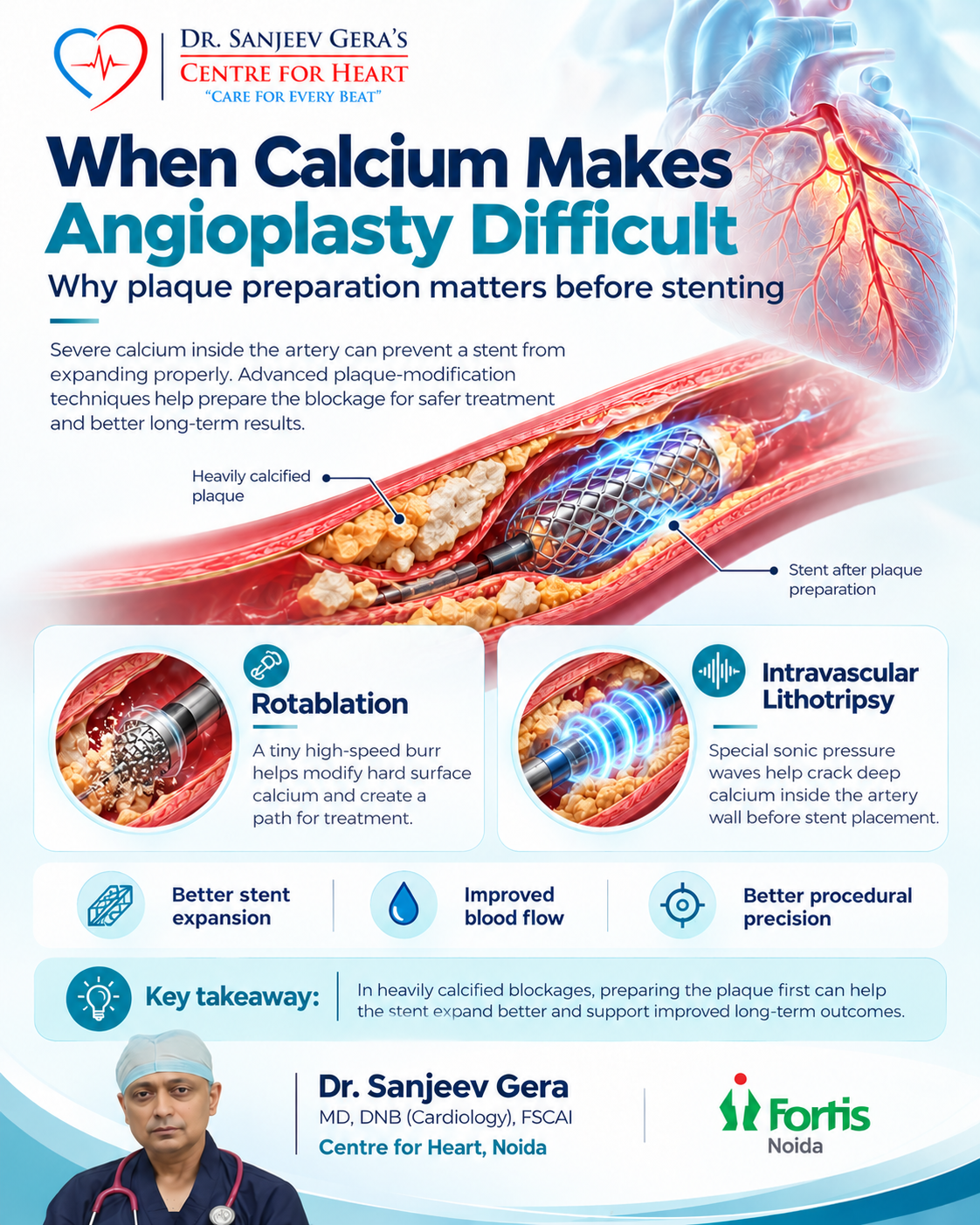
A tiny, olive-shaped burr coated with microscopic diamond chips spins at roughly 1,40,000 to 1,80,000 rotations per minute.
It gently sands away hard calcium while soft, healthy tissue flexes away. The calcium becomes particles finer than a red blood cell, which the body clears naturally.
Best for:
Similar in idea to breaking kidney stones, but far gentler and delivered from inside the artery through a special balloon.
Sonic pressure waves pass harmlessly through soft tissue but crack the calcium, even deep in the artery wall, so the artery becomes flexible again.
Best for:
| Rotablation | IVL | |
|---|---|---|
| Nickname | The Drill | Sonic Waves |
| What it does | Grinds calcium away | Cracks calcium in place |
| Works best on | Surface calcium, very tight blockages | Deep and ring-like calcium |
| Main goal | Create a channel | Make the artery flexible |
These two are not rivals. In very complex cases they are often used together: the drill first opens a path, and shockwaves then crack the deeper calcium.
An angiogram shows only the shadow of an artery and often underestimates calcium. So we frequently look inside the artery:
Intravascular Ultrasound uses sound waves to show how deep the calcium goes.
Optical Coherence Tomography uses light to measure the thickness, length and arc of calcium in fine detail.
These images tell us which tool, or combination, suits that particular artery, and later confirm that the stent has opened well. Cutting or scoring balloons and orbital atherectomy may also be chosen, depending on what the images show.
For many patients who were earlier told that angioplasty was “not possible”, these techniques have opened a real option.
Every heart procedure carries some risk, and calcified arteries are by nature more complex. Possible complications include a tear in the artery, temporary slowing of blood flow, heart rhythm changes and, rarely, a perforation.
In experienced hands and with imaging guidance these events are uncommon. Your cardiologist will explain the risks and benefits that apply to your own case.
No. Once calcium has formed, medicines cannot dissolve it. Medicines and lifestyle changes remain essential, because they slow further plaque build-up and protect the heart.
Do not stop any prescribed supplement on your own. Artery calcification is driven by the disease process in the artery wall, not simply by the calcium you eat. Discuss it with your doctor.
Sometimes it is. The choice depends on how many arteries are involved, heart function, diabetes and overall health. The decision should be individual and, ideally, taken by a heart team.
A well-prepared artery allows a well-expanded stent, which gives the best chance of a lasting result. Medicines, sugar and BP control, and not smoking matter just as much.
A heavily calcified report is not the end of the road. A detailed evaluation with Dr. Sanjeev Gera, MD, DNB (Cardiology), FSCAI, at Centre for Heart, Fortis Hospital, Noida, can help you understand your options.
Book a ConsultationDisclaimer: This article is for general patient education and is not a substitute for a personal medical consultation. Treatment decisions depend on individual evaluation.
 +(91)9810466173
 info@drsanjeevgeracardiologist.com