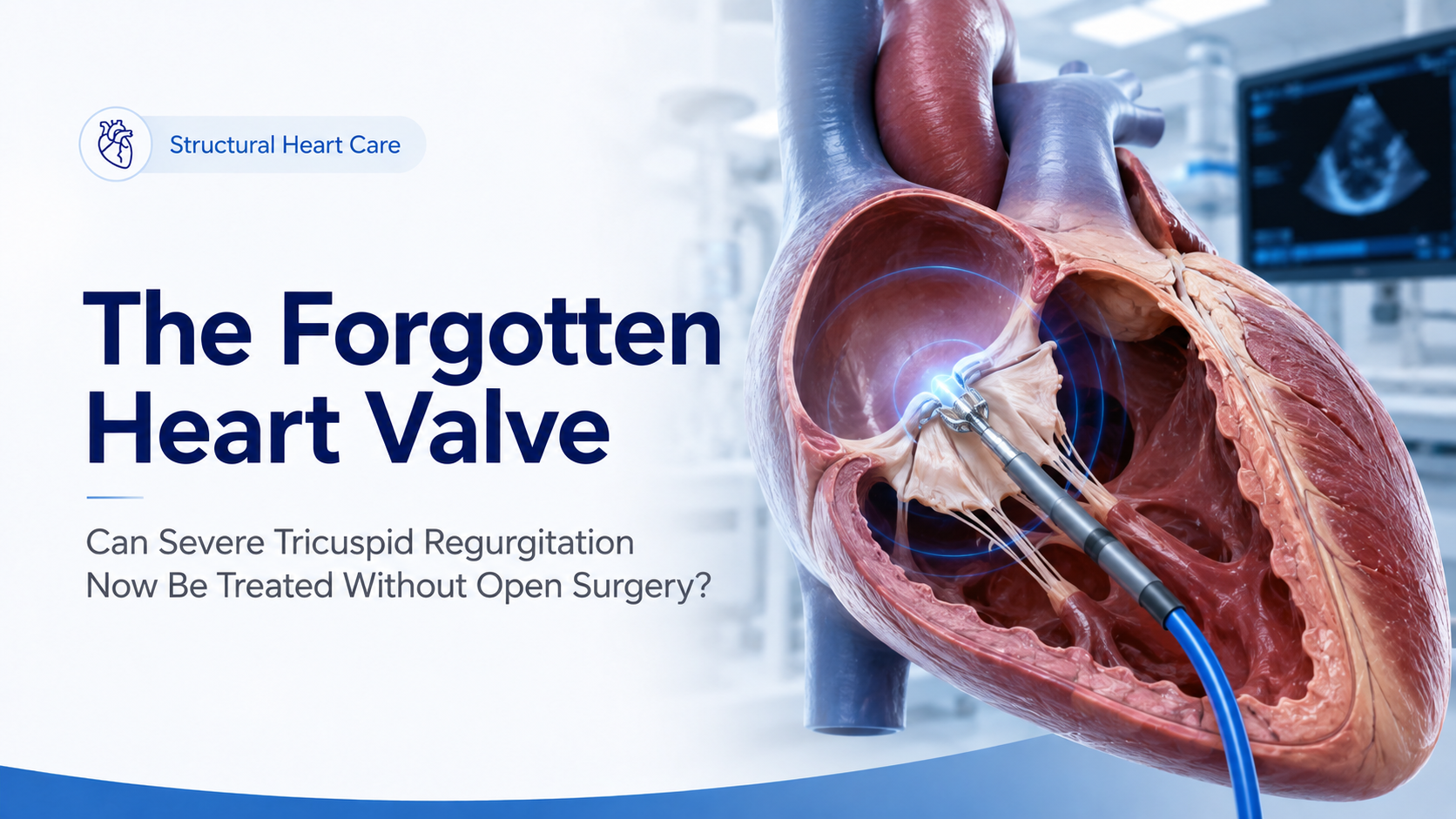
When people think about heart valve disease, the aortic and mitral valves usually receive most of the attention.
The tricuspid valve, located on the right side of the heart, has historically received far less attention. For years, severe leakage of this valve was frequently managed mainly with medicines unless the patient was already undergoing another form of heart surgery.
That approach is changing.
Advances in structural heart interventions now mean that some patients with severe symptomatic tricuspid regurgitation (TR) may be treated using catheter-based procedures instead of conventional open-heart surgery.
Transcatheter edge-to-edge repair and transcatheter tricuspid valve replacement have become important new options for carefully selected patients. The 2025 ESC/EACTS valve guidelines recognize the growing evidence for both transcatheter tricuspid repair and replacement, particularly their ability to reduce regurgitation and improve symptoms and quality of life.
But these procedures are not appropriate for every patient, and open surgery remains the right treatment in many situations.
The heart has four valves:
The tricuspid valve sits between the right atrium and the right ventricle.
Its job is simple but important.
When the right ventricle contracts, the tricuspid valve should close tightly so that blood moves forward toward the lungs rather than backwards into the right atrium.
When the valve does not close properly, blood leaks backwards.
This condition is known as:
Mild tricuspid leakage can be common and may cause no problems.
Severe tricuspid regurgitation is different.
Over time, a large amount of backward blood flow can place significant stress on the right side of the heart.
Unlike some other valve conditions, severe TR is often not caused by damage to the valve leaflets themselves.
In many patients, the valve becomes leaky because the heart chambers around it have enlarged.
This is called secondary or functional tricuspid regurgitation.
Common contributing conditions include:
Long-standing atrial fibrillation can enlarge the right atrium and stretch the tricuspid valve ring.
Mitral or aortic valve disease and left-sided heart failure can eventually increase pressure on the right side of the heart.
High pressure in the pulmonary circulation can enlarge and weaken the right ventricle.
Right ventricular enlargement can stretch the tricuspid valve and prevent its leaflets from meeting properly.
In some patients, a pacemaker or defibrillator lead crossing the tricuspid valve can interfere with leaflet movement.
Less commonly, the valve itself may be affected by congenital abnormalities, infection, trauma, rheumatic disease or other structural problems.
The latest European guidelines emphasize that the cause and mechanism of TR should be carefully defined because treatment depends heavily on why the valve is leaking.
Tricuspid regurgitation may initially progress quietly.
Because the right side of the heart can compensate for some time, patients may not recognize the seriousness of the condition until congestion becomes significant.
As TR worsens, the right ventricle must handle increasing volume overload.
Eventually this can lead to:
Severe TR is associated with a higher risk of heart failure and mortality, making it much more than a harmless echo finding.
The symptoms can look different from the classic chest-pain symptoms people associate with heart disease.
Patients may notice:
Fluid begins accumulating because blood is not moving efficiently through the right side of the heart.
Fluid may accumulate within the abdomen, a condition known as ascites.
This may occur particularly during physical activity.
Even routine activities may become increasingly difficult.
Walking distances that were previously comfortable may become exhausting.
This may occur because of fluid retention rather than body fat.
High right-sided heart pressure can cause the veins in the neck to become visibly enlarged.
Congestion of the liver and digestive system can contribute to these symptoms.
Many patients initially assume these symptoms are simply due to ageing.
That can delay diagnosis.
The most important initial test is usually an echocardiogram.
It allows the cardiologist to assess:
When a transcatheter intervention is being considered, more detailed imaging may be required.
This can include:
Modern guidelines increasingly emphasize advanced imaging because successful tricuspid intervention depends heavily on understanding the valve anatomy before the procedure.
Medicines remain extremely important.
Treatment may include:
Diuretics can significantly improve swelling and congestion.
However:
If severe valve leakage persists and the patient continues to experience symptoms, the cardiologist may need to consider whether an intervention is appropriate.
Surgical tricuspid valve repair or replacement remains an important treatment.
Surgery may be particularly appropriate when:
The challenge is that many patients with isolated severe TR are elderly or have multiple medical conditions by the time intervention is considered.
They may have:
This can make another open-heart operation considerably more complex.
That is one major reason transcatheter tricuspid therapies have attracted so much attention.
Two major catheter-based strategies have emerged:
and
They approach the same disease in very different ways.
T-TEER repairs the patient’s existing valve.
A catheter is generally introduced through a large vein, typically from the groin, and advanced into the right side of the heart.
A small implant is positioned on the tricuspid valve.
The device brings selected valve leaflets closer together.
By improving leaflet contact, the opening through which blood leaks backwards becomes smaller.
Instead of replacing the entire leaking door, the procedure helps bring the edges of the existing door together so that it closes more effectively.
One of the best-known T-TEER systems is TriClip.
The system is designed specifically to grasp the tricuspid valve leaflets and reduce regurgitation.
The U.S. FDA approved the TriClip G4 system in April 2024 for selected patients with symptomatic severe TR despite optimal medical therapy who are at increased surgical risk and have anatomy suitable for edge-to-edge repair.
Regulatory approval and availability vary between countries and hospitals.
The landmark TRILUMINATE Pivotal trial evaluated transcatheter edge-to-edge repair in patients with severe symptomatic TR.
The study demonstrated that the procedure substantially reduced tricuspid regurgitation and improved quality of life, with a favorable safety profile.
An important point for patients is that the major demonstrated early benefit was improvement in symptoms and quality of life. It should not automatically be interpreted as proof that every patient undergoing the procedure will live longer or avoid future heart-failure hospitalization.
Patient selection remains critical.
Doctors examine several anatomical factors before recommending the procedure.
They include:
If the gap is extremely large, a clip may not achieve adequate closure.
Certain leak locations are easier to treat than others.
There must be enough suitable tissue for the device to grasp.
Extremely advanced right-heart failure can make intervention less beneficial.
Severe pulmonary vascular disease may affect treatment decisions.
Existing pacing leads need careful assessment to understand whether they are causing the leakage or might interfere with treatment.
Modern valve guidelines specifically emphasize factors such as jet location, leaflet tethering, coaptation gap and pacing-lead interaction when assessing patients for transcatheter tricuspid treatment.
Sometimes the native valve anatomy is not suitable for clipping.
Another emerging option is to replace the tricuspid valve using a catheter.
This is known as:
A replacement valve is compressed onto a delivery system and advanced into the heart through the venous circulation.
The artificial valve is then implanted within the native tricuspid valve.
The aim is to dramatically reduce or eliminate backward blood flow.
The TRISCEND II trial evaluated transcatheter tricuspid valve replacement plus medical therapy against medical therapy alone in 400 patients with severe symptomatic TR.
The trial found that valve replacement was superior for its primary composite endpoint, with benefits driven largely by improvements in symptoms and quality of life. More than 95% of treated patients had TR reduced to mild or less.
This represents a major development in a field where treatment options were historically limited.
However, replacement introduces different considerations than repair, including the need to evaluate bleeding risk, anticoagulation requirements, conduction issues, right ventricular adaptation and valve anatomy.
There is no universal answer.
The goal is not to choose the newest technology.
It is to choose the right technology for the individual patient.
In some patients, neither approach will be appropriate.
A multidisciplinary structural-heart team should make this decision after detailed imaging.
The principle is similar in that both procedures use catheter-based technology to treat a heart valve without conventional open-heart surgery.
However, the tricuspid valve presents unique challenges.
It is:
Treating the tricuspid valve therefore requires dedicated devices and specialized imaging.
The exact procedure depends on the device, but a typical treatment involves several steps.
The catheter is generally introduced through a large vein, frequently in the groin.
Advanced echocardiography helps the structural-heart team navigate inside the heart.
The repair or replacement device is carefully positioned at the tricuspid valve.
For TEER, the valve leaflets are captured.
For replacement, a new valve is implanted.
Echocardiography checks:
Because there is no sternotomy and usually no heart-lung bypass machine, recovery can be different from conventional open-heart surgery.
For suitable high-risk patients, transcatheter treatment may offer:
These benefits should always be weighed against procedural risks and the patient’s overall prognosis.
Yes.
A catheter-based procedure is still a major cardiac intervention.
Possible complications can include:
Valve replacement and valve repair also have different risk profiles.
A detailed discussion with the treating heart team is essential.
One of the biggest challenges with tricuspid regurgitation is waiting too long.
If treatment is delayed until there is:
then correcting the valve may not completely reverse the damage that has already occurred.
This is why today’s approach increasingly emphasizes earlier recognition and timely referral rather than waiting until right-sided heart failure becomes advanced. Current international guidance reinforces specialized Heart Team evaluation for complex tricuspid disease.
No.
Some patients may remain stable with medical treatment and regular follow-up.
Others may have advanced disease where intervention is unlikely to provide meaningful benefit.
Some may benefit more from surgery.
Others may be excellent candidates for transcatheter repair or replacement.
The decision requires assessment of:
Yes, in selected patients. Catheter-based tricuspid repair and replacement procedures can treat the valve through the venous circulation without conventional open-heart surgery.
It is an interventional procedure, but it is not traditional open-heart surgery. The device is delivered through a catheter.
Medicines can reduce fluid overload and control contributing conditions, but they generally do not physically repair severe valve leakage.
Sometimes yes.
But the pacing lead may affect both the cause of the TR and the technical approach to treatment, so detailed imaging is essential.
Not necessarily.
Replacement can virtually eliminate TR in many appropriately selected patients, whereas repair preserves the patient’s native valve and may have other advantages.
The best approach depends on anatomy and clinical circumstances.
Not always.
If TR is an important contributor to right-sided heart failure, reducing the leakage can improve symptoms considerably.
However, underlying heart muscle disease, pulmonary hypertension, atrial fibrillation and other conditions may still require long-term treatment.
Structural heart medicine is changing rapidly.
A patient with severe tricuspid regurgitation who was considered too high-risk for surgery several years ago may today have additional treatment possibilities.
Transcatheter edge-to-edge repair and transcatheter valve replacement have significantly expanded what can be considered for patients with severe symptomatic TR. Randomized trials have shown substantial reductions in regurgitation and meaningful improvements in quality of life in appropriately selected patients.
But technology alone is not the answer.
The most important questions remain:
Why is the valve leaking?
How advanced is the right-heart damage?
Is the anatomy suitable for repair or replacement?
Would surgery provide a better result?
And is intervention being considered early enough to make a meaningful difference?
Those questions require comprehensive cardiac evaluation and a multidisciplinary Heart Team.
Dr. Sanjeev Gera
MBBS, MD – Medicine, DNB – Cardiology
Cardiologist | 20 Years Experience
Rasoolpur Nawada, Industrial Area,
Sector 62, Noida, Uttar Pradesh – 201301
Monday – Saturday | 8:30 AM – 5:30 PM
Appointments:
+91 9810466173
+91 7303770451
BF-45, 93 & 94, Phase-2, Plot A&B, Tower-B,
Spectrum Mall, Sector 75, Noida, Uttar Pradesh – 201316
Monday – Saturday | 7:00 PM – 9:30 PM
Appointments:
+91 9810466173
+91 7303770451
Note: All interventional procedures are performed at Fortis Hospital, Noida.
If an echocardiogram shows severe TR—particularly when accompanied by swelling, breathlessness, abdominal fluid retention, fatigue or repeated heart-failure admissions—it may be appropriate to undergo further assessment rather than simply continuing medications indefinitely.
Modern treatment may include medical therapy, surgery, transcatheter valve repair or transcatheter valve replacement depending on the individual patient’s condition.
Medical Disclaimer: This article is for patient education and does not replace consultation with a cardiologist. Availability and regulatory approval of individual transcatheter tricuspid devices vary by country and hospital, and treatment must be individualized after specialist evaluation.
 +(91)9810466173
 info@drsanjeevgeracardiologist.com