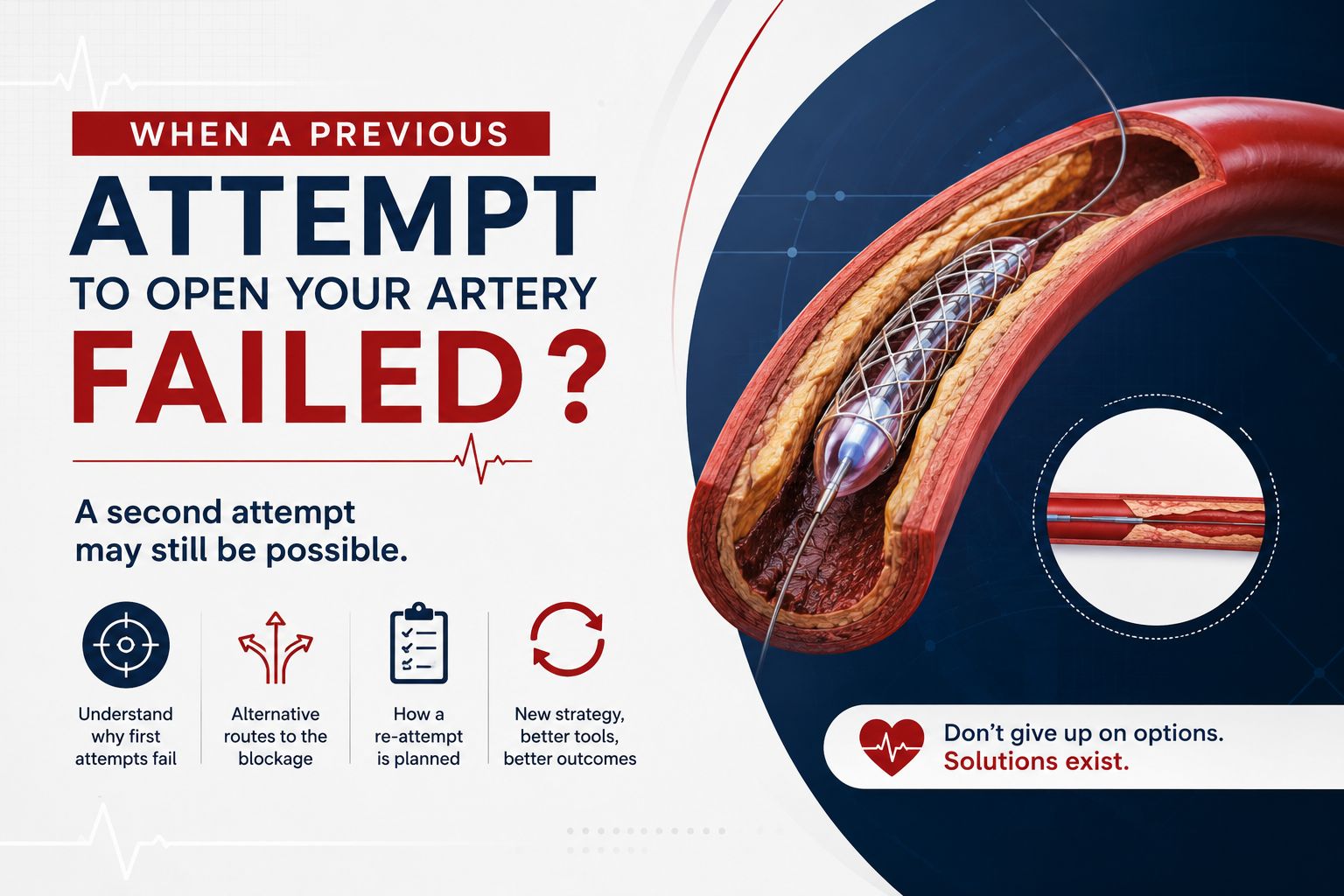
Being told that an angioplasty attempt had to be stopped can be frustrating and worrying.
Patients often come away with questions such as:
“Why couldn’t the doctor cross the blockage?”
“Does this mean the artery can never be opened?”
“Is another attempt too risky?”
“What would be different the second time?”
A failed first attempt does not always mean the artery is permanently untreatable.
Some coronary blockages, especially Chronic Total Occlusions (CTOs), are technically difficult to cross. In selected patients, a second attempt may be possible using a different strategy, more specialised equipment, better imaging, alternative routes to the blockage, or a different procedural plan.
The important question is not simply whether another attempt can be made.
It is:
“Is there a reasonable chance that a second procedure will improve symptoms or quality of life, and can it be performed with acceptable risk?”
Routine angioplasty usually involves passing a fine guidewire through a narrowed artery, expanding the blockage with a balloon, and placing a stent.
But some blockages are much more difficult.
A procedure may need to be stopped when the cardiologist cannot safely cross the blockage or when continuing would create unnecessary risk.
This is particularly common in:
Stopping a procedure does not necessarily mean something went wrong.
Sometimes the safest decision is to stop, reassess the anatomy, and plan a more advanced strategy rather than continue aggressively.
There are several possible reasons.
The beginning of a CTO may be extremely hard or difficult to identify.
Instead of having a clear opening, the artery may end in a blunt, calcified cap.
The guidewire may repeatedly slide into the wrong plane rather than entering the true channel of the artery.
A short blockage may be easier to cross.
A long CTO creates a much more difficult path.
The longer the occluded segment, the greater the chance that the guidewire may leave the original vessel channel or fail to reach the artery beyond the blockage.
Calcium can make coronary blockages feel almost like stone.
Even specialised guidewires may struggle to penetrate heavily calcified segments.
And even if the wire crosses, balloons may not expand adequately without additional plaque-modification techniques.
Some coronary arteries have multiple bends and curves.
This makes it more difficult to control the wire and supporting catheters.
A technically difficult angle at the beginning of the blockage can make even a relatively short CTO challenging.
During CTO angioplasty, the guidewire may sometimes travel between layers of the artery rather than through the original channel.
This is known as a subintimal position.
In some procedures, this can be corrected using specialised re-entry techniques.
But if the anatomy is unfavourable, the safest option may be to stop and plan another strategy.
CTO procedures can take much longer than routine angioplasty.
At some point, the cardiologist may decide that continuing would expose the patient to too much:
Stopping at that point can be an appropriate safety decision.
No.
A previous failed attempt may actually provide useful information for planning the next procedure.
The first angiogram can show:
A re-attempt is therefore not necessarily a repetition of the first procedure.
It can be a completely different strategy.
A carefully planned re-attempt may involve several changes.
There are many types of CTO guidewires.
Some are designed to:
The cardiologist may escalate from softer wires to more specialised high-penetration wires depending on the anatomy.
A microcatheter is a very small catheter used to support and control the guidewire.
It can help:
Microcatheters are an important part of complex CTO angioplasty.
Imaging such as IVUS — Intravascular Ultrasound — can sometimes provide important information that cannot be seen clearly on standard angiography.
It may help the cardiologist understand:
In selected cases, this information can completely change the approach.
One of the major differences between routine angioplasty and advanced CTO treatment is that the blockage does not always have to be approached from the same direction.
There are several possible strategies.
This means approaching the CTO from the normal direction of blood flow.
The cardiologist attempts to enter the blockage at its beginning and cross toward the artery beyond it.
This is usually the most straightforward approach when the anatomy is favourable.
Sometimes the guidewire cannot pass directly through the centre of the blockage.
Instead, a controlled pathway may be created around the blocked segment within the vessel wall.
The guidewire is then redirected back into the true artery beyond the blockage.
This is known as dissection and re-entry.
It is an advanced technique and is used only when appropriate.
In some cases, the blockage may be easier to approach from the opposite side.
The cardiologist may navigate through small collateral blood vessels that connect neighbouring coronary arteries.
The guidewire is then brought toward the blocked artery from behind.
This is called the retrograde approach.
It can be particularly useful when:
The retrograde technique is highly specialised and should only be used in carefully selected patients.
A second CTO procedure should not be approached as:
“Let us just try again.”
It should be planned.
The cardiologist may review the previous angiogram frame by frame and assess several features of the blockage.
These include:
This helps determine the most appropriate crossing strategy before the procedure begins.
No.
A re-attempt should only be considered when the expected benefit is meaningful.
The cardiologist may ask:
If the patient has few symptoms and the expected benefit is limited, another procedure may not be necessary.
The main expected benefit of successful CTO treatment is usually symptom relief and improved quality of life.
In selected patients, opening the artery may lead to:
Some patients only realise how much they had reduced their activity after symptoms improve.
It may in some patients, but not in everyone.
If the heart muscle supplied by the blocked artery is still alive but receiving inadequate blood, restoring blood flow may improve its performance.
However, if the muscle has already been permanently scarred by an old heart attack, opening the artery may not restore normal function.
This is why viability and the amount of heart muscle involved may sometimes be assessed before another procedure.
A CTO re-attempt can be more complex than standard angioplasty.
Potential risks can include:
The exact risk varies greatly depending on the patient and the anatomy.
That is why the decision should be based on expected benefit versus procedural risk.
There is no single waiting period that applies to every patient.
The timing depends on:
Some patients may undergo another procedure after careful reassessment, while others may need a longer recovery period.
The timing should be individualised.
Minor dissections or small areas of vessel-wall injury may occur during complex CTO procedures.
In many cases, these can heal with time.
A future attempt may then be planned using a different route.
This is another reason why immediate repeated attempts are not always appropriate.
Sometimes allowing the vessel to heal before reassessing can improve safety.
Depending on the clinical situation, your cardiologist may recommend:
The previous angiogram is extremely important.
The entire first attempt should be reviewed, not just the final image.
This helps assess:
A stress test may help determine whether the blocked artery is causing significant reduction in blood flow during exertion.
In patients with reduced heart function, additional imaging may help determine whether the affected heart muscle is still alive and likely to benefit from restored circulation.
Because CTO procedures may require significant contrast, kidney function is an important part of planning.
Sometimes, yes.
A second angioplasty attempt is not always the best option.
Bypass surgery may be more appropriate when the patient has:
The decision should consider the entire coronary circulation, not just one blocked artery.
If an earlier procedure was unsuccessful, consider asking your cardiologist:
Why did the first attempt fail?
Was the blockage too hard, long or calcified?
Would the second procedure use a different approach?
Could a retrograde technique be considered?
Would IVUS or another imaging technique help?
How experienced is the centre with complex CTO angioplasty?
What is the expected chance of success in my case?
What symptoms are we trying to improve?
Would bypass surgery be a better option?
What are the specific risks in my case?
These questions can help you understand the purpose of another procedure.
A complex coronary blockage can defeat even a carefully performed first attempt.
But that does not automatically mean:
“The artery can never be opened.”
Sometimes the safest first procedure is the one that stops before unnecessary risk is taken.
A second procedure may then be planned with:
The decision should always be based on one central question:
Will reopening this artery provide a meaningful benefit to the patient?
If the answer is yes, and the anatomy is suitable, a planned re-attempt at a centre experienced in complex coronary intervention may be worth discussing.
Yes, in selected patients. A previous failed attempt does not necessarily mean the artery cannot be treated. A second attempt may use different equipment or crossing strategies.
The procedure may be stopped if the guidewire cannot safely cross the blockage, if the anatomy is more complex than expected, or if continuing would expose the patient to excessive risk.
It can be. A re-attempt may involve different guidewires, microcatheters, IVUS imaging, a different entry strategy or even approaching the blockage from the opposite direction.
It is an advanced CTO technique in which the blocked artery is approached from behind using small collateral vessels connecting neighbouring coronary arteries.
Yes, depending on the reason for the first failure, the anatomy and the strategy used for the second attempt.
No. Another attempt is only appropriate when the expected symptom or quality-of-life benefit justifies the procedural risk.
It can in appropriately selected patients if the blocked artery is contributing to reduced blood supply to viable heart muscle.
Yes. In some patients with extensive or complex coronary disease, bypass surgery may be the better treatment.
Dr. Sanjeev Gera
MD, DNB (Cardiology), FSCAI
Centre for Heart, Noida
Fortis Noida
If a previous attempt to open a completely blocked coronary artery was unsuccessful, it may be useful to have the angiogram and overall clinical condition reassessed before deciding that no further treatment is possible.
A re-attempt should not simply repeat the first procedure.
It should be based on a new strategy, careful planning and a clear expected benefit for the patient.
 +(91)9810466173
 info@drsanjeevgeracardiologist.com