
In the rapidly evolving field of interventional cardiology, Transcatheter Aortic Valve Replacement (TAVR) has become a beacon of hope for high-risk patients once considered inoperable. Today, we bring you the inspiring story of a 65-year-old woman whose journey from chronic fatigue and recurrent falls to renewed energy was made possible by this minimally invasive technique—especially when traditional surgery posed serious risks due to her underlying sleep apnea.
Aortic stenosis (AS) is one of the most common and life-threatening valvular heart diseases, particularly in the elderly. It occurs when the aortic valve—the gateway between the heart and the body—narrows and restricts blood flow. Over time, the heart works harder to push blood through this tight opening, leading to symptoms such as:
Fatigue
Breathlessness
Chest discomfort
Fainting spells (syncope)
Recurrent falls
Swollen ankles
If left untreated, severe AS can lead to heart failure and death.
Sleep apnea, particularly Obstructive Sleep Apnea (OSA), is a condition where breathing stops intermittently during sleep. Though often underdiagnosed, it is a major risk factor for cardiovascular diseases and surgical complications. For patients with OSA, anesthesia can worsen airway collapse, increase blood pressure fluctuations, and lead to dangerous post-operative events.
In high-risk cardiac patients, this condition makes open-heart surgery potentially fatal—a reality that made TAVR the only safe alternative for our patient.
Recurrent Falls
Severe Fatigue
Low Blood Pressure
Diagnosed Obstructive Sleep Apnea
Considered High-Risk for Open-Heart Surgery
The patient was brought to our care after experiencing multiple unexplained falls and a persistent lack of energy. She reported increasing shortness of breath while performing basic household tasks and had fainted twice in the last month. Upon investigation, she was diagnosed with critical aortic stenosis, a condition where surgical valve replacement is often necessary.
However, her medical history told a different story.
She was also diagnosed with moderate to severe obstructive sleep apnea—a condition that could dramatically increase her risk during general anesthesia and open-heart surgery.
TAVR, unlike surgical aortic valve replacement (SAVR), does not require opening the chest or putting the patient on a heart-lung bypass machine. The procedure is typically done through a catheter inserted via the femoral artery (in the groin) under mild sedation or local anesthesia.
No need for general anesthesia
Reduced hospital stay
Faster recovery
Lower risk of post-operative respiratory complications
Minimal blood loss
In this case, the interventional heart team decided to proceed with TAVR, given her contraindications for open surgery.
The patient underwent successful TAVR under conscious sedation. The procedure lasted just under two hours. A balloon-expandable valve was placed across the diseased native valve, restoring normal blood flow immediately.
No need for ventilator support
No ICU stay required
Mobilized within 24 hours
Discharged on day 3 post-procedure
Significant improvement in fatigue and dizziness within a week
The collaborative effort of the interventional cardiologists, anesthesiologists, pulmonologists, and nursing staff ensured a smooth recovery with careful monitoring of her OSA parameters.
Post-TAVR, the patient’s life saw a remarkable transformation. Here’s how she described her experience:
“I used to feel tired even getting out of bed. Now I walk without support, sleep better, and feel more confident. I never imagined such a change was possible without major surgery. TAVR saved my life.”
The family expressed immense gratitude to the doctors and medical team who turned what seemed like a dead-end into a hopeful new chapter.
| Feature | TAVR | Surgical AVR |
|---|---|---|
| Invasiveness | Minimally invasive | Open chest |
| Anesthesia | Local/Conscious Sedation | General Anesthesia |
| Hospital Stay | 2–3 days | 7–10 days |
| Recovery Time | 1–2 weeks | 6–8 weeks |
| Risk for High-Risk Patients | Lower | Higher |
Sleep apnea is a silent contributor to many cardiac conditions, including:
Hypertension
Arrhythmias
Stroke
Heart failure
Sudden cardiac death
In patients undergoing surgery, untreated sleep apnea increases the risk of:
Perioperative hypoxia
Difficult airway management
Prolonged hospital stay
Post-operative cardiac events
This is why screening for OSA is crucial before any cardiac surgery or intervention. For high-risk individuals like our patient, TAVR offers a new lease on life.
Behind every successful TAVR procedure is a team of specialists, including:
Interventional Cardiologists – who perform the valve replacement
Cardiac Anesthesiologists – who ensure safe sedation without compromising breathing
Pulmonologists – who manage comorbid sleep apnea and breathing issues
Cardiac Imaging Specialists – who use echocardiography and CT to plan the procedure
Rehabilitation Experts – who help patients return to normal life
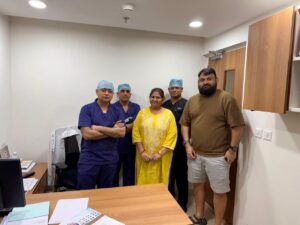
The image from the case reflects just that—a dedicated team standing proud with the patient and family after a successful TAVR.
Yes, in fact, TAVR is often preferred over open surgery in elderly or high-risk patients with sleep apnea, as it avoids general anesthesia and invasive procedures.
Typically 1.5 to 2 hours. Most patients are discharged within 3–5 days.
Yes. TAVR is usually performed under conscious sedation or local anesthesia, especially for high-risk patients.
TAVR has a success rate of over 95%, with many patients showing immediate improvement in symptoms.
Yes. TAVR does not cure sleep apnea. Continued CPAP therapy is recommended post-procedure for optimal outcomes.
These risks are generally lower than those with open-heart surgery in high-risk patients.
Talk to a cardiologist today. With newer technologies and safer alternatives like TAVR, no one should be denied treatment because of surgical risk.
 +(91)9810466173
 info@drsanjeevgeracardiologist.com