Most people think heart disease affects only the heart. But inside the body, nothing works alone.
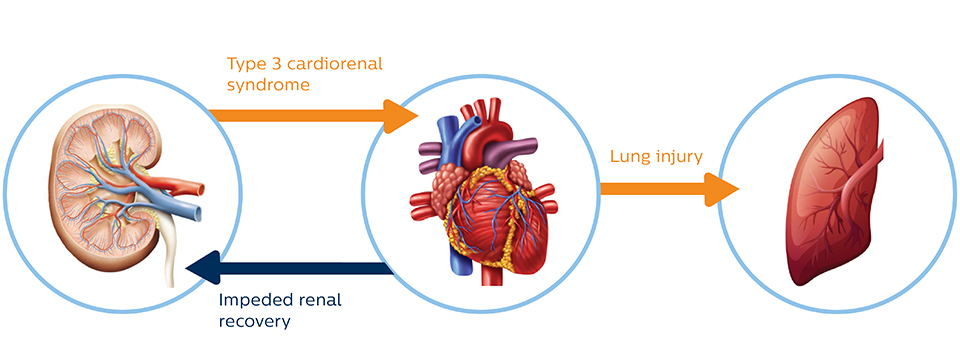
Your heart, kidneys, and lungs operate like a tightly woven triangle — a disturbance in one corner can shake the entire structure.
When the heart weakens, it quietly triggers a dangerous chain reaction.
Your kidneys start struggling.
Your lungs begin filling with fluid.
Your body slips into a vicious cycle that gets worse unless someone breaks it in time.
This silent chain reaction is called the Heart–Kidney–Lung Domino Effect, and recognizing it early can save your life.
The heart’s job is simple but powerful — pump oxygen-rich blood to every organ.
But when heart function drops (due to heart failure, heart attack, valve disease, hypertension, or long-standing diabetes), blood flow slows down. Pressure builds. Fluid leaks.
The body senses this drop in supply and starts panicking internally:
Hormones get activated to retain water.
Blood vessels tighten to maintain pressure.
The heart beats harder, tiring even more.
This is where the dominoes start falling.
Kidneys need a strong, steady blood flow to filter toxins.
When the heart fails, kidney perfusion drops.
The kidneys interpret this as “the body is losing fluid,” even though it is actually overloaded.
So they mistakenly:
Retain salt and water
Produce hormones that increase blood pressure
Overwork themselves until kidney failure sets in
This dangerous loop is known as Cardio-Renal Syndrome.
The weaker the heart becomes, the weaker the kidneys get.
And the weaker the kidneys become, the harder it is for the heart to recover.
Once the kidneys retain more water and the heart can’t pump efficiently, the extra fluid has nowhere to go.
It backs up into the lungs — leading to:
Breathlessness
Cough
Frothy sputum
Chest tightness
Difficulty lying flat
This condition is called Pulmonary Congestion or Heart Failure with Fluid Overload.
Even simple tasks like walking or speaking become a struggle.
Many patients describe it as “drowning from the inside.”
Here’s how the internal destruction unfolds:
Heart weakens → blood flow drops
Kidneys retain fluid → swelling increases
Extra fluid overloads the heart → heart failure worsens
Fluid leaks into the lungs → breathlessness increases
Low oxygen harms all organs, including the brain
Kidneys worsen further, completing the destructive loop
Without early intervention, this spiral becomes life-threatening.
Fatigue
Chest heaviness
Palpitations
Swelling of feet
Reduced urine output
Sudden weight gain
Swelling of legs and abdomen
Nausea, confusion
Breathlessness on lying down
Sudden night-time breathlessness
Persistent cough with frothy sputum
Blue lips or fingertips
Ignoring early symptoms is one of the biggest reasons patients reach hospitals late.
Your heart, kidneys, and lungs share responsibilities:
The heart pumps blood.
The kidneys regulate fluid and electrolytes.
The lungs oxygenate the blood the heart pumps.
If any one organ weakens, the other two overwork to compensate.
But compensation has a limit — and when the limit is crossed, all three start failing together.
This is why heart failure is not just a “heart problem.”
It is a whole-body problem.
Modern cardiology focuses not only on treating the heart but on preserving kidney and lung function simultaneously.
Treatments include:
RAAS inhibitors
ARNI
Beta-blockers
Diuretics (to remove excess fluid)
SGLT2 inhibitors (protect heart + kidneys)
Coronary angioplasty
Bypass surgery
Mitral or aortic valve repair/replacement
CRT or ICD devices
TAVR for severe valve diseases
Controlled hydration
Low-salt diet
Avoiding kidney-toxic medications
Monitoring of creatinine and electrolytes
Non-invasive ventilation (NIV/CPAP)
Diuretics to reduce lung congestion
Oxygen therapy
Treating underlying lung infections
Low-sodium diet
Fluid restriction (in selected cases)
Daily weight monitoring
Regular check-ups
Controlling hypertension and diabetes
The earlier treatment is started, the more likely it is to stop the dominoes from falling.
Yes. Reduced heart pumping reduces kidney blood flow, leading to reduced filtration and kidney injury.
Because extra fluid collects in the lungs when the weakened heart cannot pump efficiently.
Absolutely. When kidneys retain excess fluid and sodium, the heart becomes overloaded and weakens further.
Yes, a low-salt diet, fluid control, weight monitoring, diabetes/hypertension control, and early diagnosis help significantly.
If you notice:
Increasing breathlessness
Swelling in feet
Sudden weight gain
Reduced urine output
Fatigue or chest discomfort
Seek medical attention immediately.
If detected early — YES.
With advanced treatments, patients can recover heart function, prevent kidney injury, and breathe normally again.
 +(91)9810466173
 info@drsanjeevgeracardiologist.com